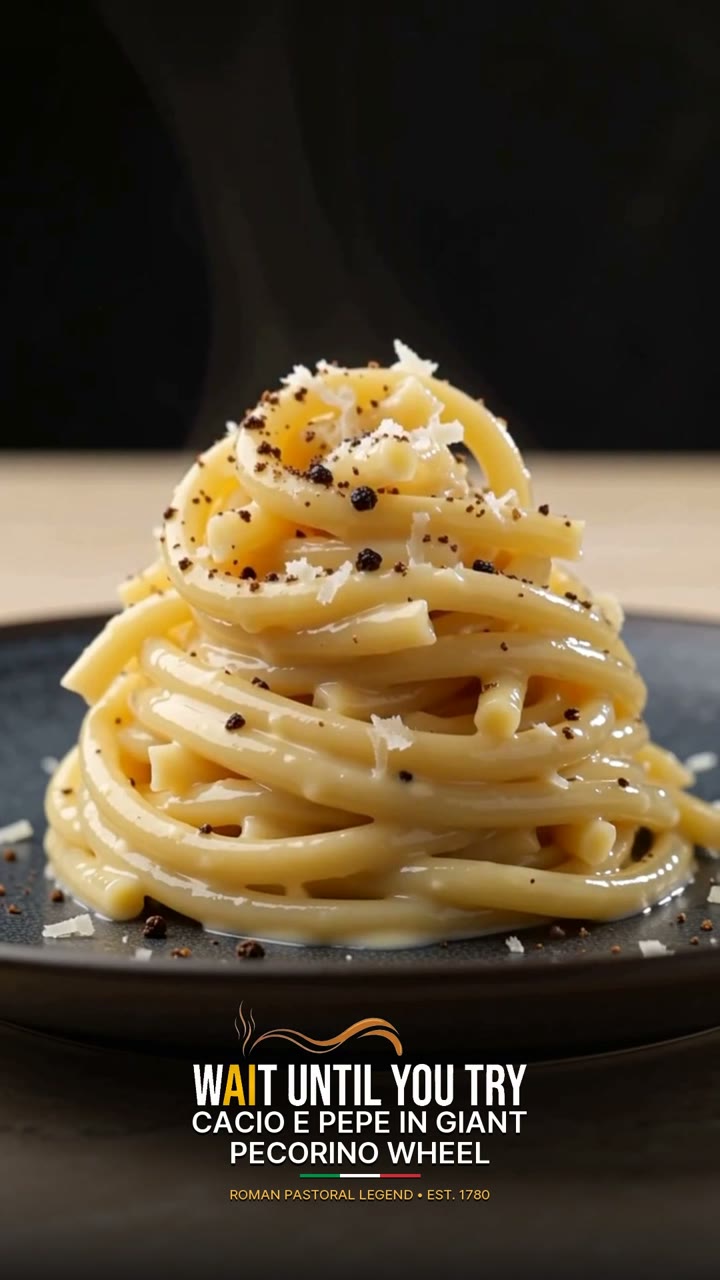
The story and science behind the dish · recipe above ↑
Roman Carbonara: The Five-Ingredient Classic, Explained
What is authentic Roman carbonara?
Authentic Roman carbonara is a pasta dressed only with cured pork jowl (guanciale), Pecorino Romano, egg, black pepper and a little salt, bound into a glossy sauce by the heat of the pasta and its starchy cooking water. The International Pasta Organisation, which co-promotes Carbonara Day, lists exactly these five ingredients as the canon. There is no cream, no garlic and no onion.
Rigatoni is a common Roman choice because its ridges and wide tubes hold the sauce; Wanted in Rome names spaghettoni and rigatoni as the preferred shapes. Our film uses rigatoni.
Why is there no cream in carbonara?
Carbonara gets its creaminess from egg yolk and cheese emulsified with pasta water, so cream isn't needed, and Roman cooks won't allow it. Italy's farmers' association Coldiretti cites cream in place of pecorino, a habit it attributes to Belgium, as a typical foreign distortion; in the same Carbonara Day report it says three in four Italians are disappointed by "Italian" dishes abroad.
Guanciale, pancetta or bacon: which should you use?
Use guanciale if you can find it. Guanciale is cured pork jowl (the cheek), while pancetta comes from the belly and bacon is the familiar belly cut used outside Italy. Coldiretti names bacon in place of guanciale as a common mistake in English-speaking countries.
| Cut | Part of the pig | How it behaves in carbonara | Roman verdict |
|---|---|---|---|
| Guanciale | Jowl (cheek) | Renders plenty of fat; crisp outside, tender inside | The traditional choice |
| Pancetta | Belly | Leaner render, milder flavour | Used in the first recipe printed in Italy (1954); the usual substitute |
| Bacon | Belly (as sold outside Italy) | May be smoked, which changes the flavour | Named by Coldiretti as a foreign deviation |
Which cheese goes in carbonara?
Pecorino Romano is the cheese of Roman carbonara. According to the Pecorino Romano consortium, Pecorino Romano DOP is made exclusively from sheep's milk, curdled with lamb's rennet paste, and produced only in Lazio, Sardinia and the province of Grosseto.
Its salty, sharp flavour is why the pasta water for carbonara is only lightly salted. The consortium's grading sheet notes that the grating version is aged at least eight months, so it is firm and dry enough to grate finely.
How do you keep the eggs from scrambling?
Keep the sauce below the temperature at which egg yolk sets, by mixing it with the pasta off the heat. The Institute of Food Science and Technology gives about 65°C (149°F) for yolk coagulation and about 70°C (158°F) for full coagulation, so a pan that is still on the burner will turn the sauce into scrambled egg in seconds.
Starchy pasta water is the other half of the technique. Physicists studying cacio e pepe, carbonara's cheese-and-pepper cousin, found that when starch falls below about 1% of the cheese mass the sauce clumps (Bartolucci et al., Physics of Fluids, 2025). The same principle applies to carbonara: a splash of cloudy pasta water keeps the cheese smooth.
The method, in order:
- Render the guanciale slowly in a dry pan over medium-low heat until it is crisp outside and tender inside, then turn the heat off and keep the fat.
- Whisk the yolks with finely grated Pecorino Romano and plenty of cracked black pepper into a thick paste, then loosen it with a spoonful of the warm fat.
- Cook the pasta in lightly salted water until al dente and move it straight into the pan with the guanciale, off the heat.
- Let the pan cool for a moment, then add the egg-and-cheese paste with a splash of pasta water.
- Toss continuously until the sauce turns glossy and coats every piece, adding pasta water a little at a time if it tightens.
- Serve at once, topped with the crisp guanciale, more pecorino and pepper.
Where does carbonara come from?
Nobody has proved where carbonara was invented; the documented record starts only around 1950. As chronicled in culinary histories documented on Wikipedia, a 1950 La Stampa article first recorded the dish when American officers in Rome's Trastevere district requested "spaghetti alla carbonara".
The first recipe printed in Italy appeared in La Cucina Italiana in August 1954, and it would surprise a Roman purist today: spaghetti, pancetta, Gruyère, garlic and two eggs, according to Gambero Rosso. Gambero Rosso also reports an American printing two years earlier, in a 1952 Chicago restaurant guide.
The origin stories that circulate remain unproven:
- American rations. Allied soldiers in 1944 combined pasta with bacon and powdered egg, one of three theories listed by the International Pasta Organisation.
- The charcoal burners. Apennine carbonari (charcoal burners) cooked a simple dish of cheese and eggs, and their name is often linked to the dish's.
- A cook's claim. Renato Gualandi said he created it in Riccione in 1944 for an Allied dinner (Gambero Rosso), though De Cecco's magazine notes that his own autobiography never mentions carbonara.
Today's version took shape over the following decades. Gambero Rosso credits Luigi Carnacina's 1960 cookbook with introducing guanciale, and by the 1990s yolk, pecorino, guanciale and pepper had become the standard.
When is Carbonara Day?
Carbonara Day is celebrated every year on 6 April. It was launched in 2017 by Italian pasta makers with the International Pasta Organisation. The IPO reports that the campaign reaches over 200 million people worldwide each spring.
Frequently asked questions
Can I use whole eggs instead of yolks?
Yes, though cooks disagree. Today's Roman standard, settled by the 1990s according to Gambero Rosso, uses yolks, while the first recipe printed in Italy, in 1954, called for two eggs. Yolks give a richer, silkier sauce; whole eggs make it lighter but set faster, so work off the heat.
Can I use Parmigiano instead of Pecorino Romano?
You can, but the dish will taste different. Pecorino Romano is a sheep's-milk cheese, saltier and sharper than cow's-milk Parmigiano, and it is the cheese named in the Roman canon. Some cooks blend the two for a milder sauce.
Is carbonara safe with lightly cooked eggs?
Traditional carbonara sets the eggs with residual heat and may not reach the 71°C (160°F) standard for fully set egg dishes. For households where lightly cooked eggs are a concern, using pasteurized eggs allows the yolks to emulsify smoothly into sauce while eliminating food safety risks.
Why does my carbonara turn out dry or clumpy?
Usually because too little pasta water went in or the pan was too hot. Add the cloudy cooking water a spoonful at a time and toss off the heat until the sauce turns glossy.
Watch it, cook it, tell us what's next
The film at the top of this page shows every step in under 30 seconds, set to an original (AI-generated) recipe song. Watch it on YouTube, Instagram or TikTok, and tell us which dish we should cook next.
About this page: the film and its song are AI-generated; the written recipe and this article were researched and written with AI assistance from the sources linked above.