The story and science behind the dish · recipe above ↑
Crispy 15-Layer Garlic-Herb Butter Potato Pave Stacks — Technique & Science
Fifteen paper-thin Yukon Gold slices bathed in warm garlic-thyme heavy cream, baked tender at 375°F / 190°C, chilled solid into crisp laminated layers, cut into uniform square cubes, and basted in vigorously boiling browned butter achieve what oven fries never can: shatteringly crisp golden borders wrapped around a custardy, cream-infused potato center. Explore more savory sides across our recipe catalog.
Why does layered potato pave crisp better than roast chunks?
| Method | Moisture Control | Surface Crispness | Interior Texture | Thermal Step |
|---|---|---|---|---|
| Whole roasted chunks | Uneven steam pocket | Irregular blistered spots | Floury to dry center | Single oven bake |
| Pan-fried slices | Surface moisture splatters | Soft center curl | Dense starchy core | Direct skillet sear |
| Baked 15-layer pave | Starch and cream pressed & set | Glassy all-sided crust | Silky custardy layers | Bake 375F, press flat, chill, cube, sear |
The classic French pave de pommes de terre, popularized in modern steakhouses by chefs such as Thomas Keller alongside traditional gratin dauphinois, works because thinly shaved potato coins release natural surface starch into warm cream as they bake gently at 375°F (190°C) inside a deep rectangular pan. Pressing the hot baked layers evenly under a nested second pan immediately after baking compacts every horizontal seam tightly together before overnight chilling sets the starch-cream matrix into a firm golden-crusted block that cuts cleanly on walnut hardwood into identical square cubes.
How does cream and boiling brown butter build crispness?
Shingling 1.5 mm potato slices tightly in an open baking tray allows warm heavy cream infused with garlic and fresh thyme sprigs to coat every seam evenly without diluting surface starch. Heating cream slowly stabilizes the fat-water matrix described in culinary emulsion science. During skillet finishing, actively boiling milk solids caramelize through the Maillard reaction, coating crisp square layers in nutty, savory depth while keeping the center creamy.
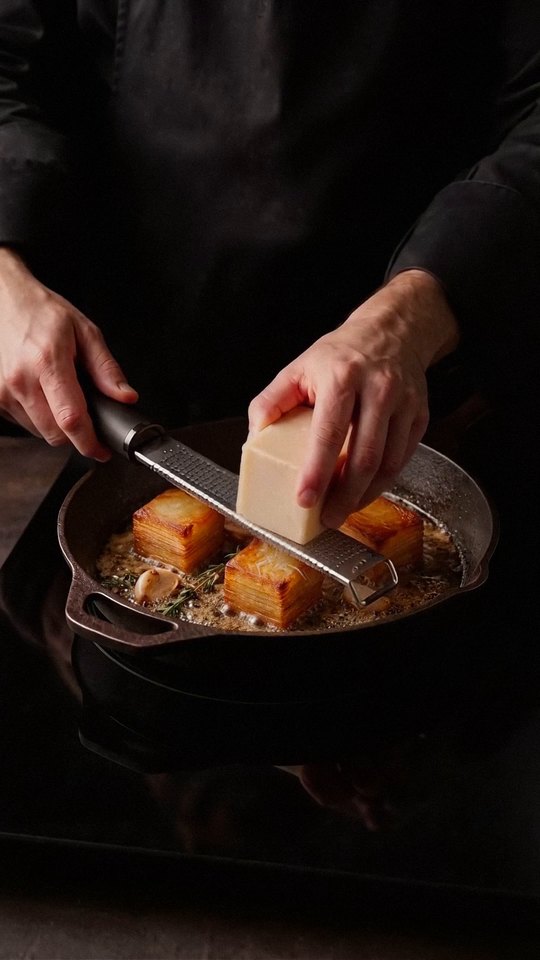
Aged Parmigiano cheese grated fresh off a fine micro-etched rasp adds savory glutamate crystals that melt gently onto the hot crisp tops.
What pan depth and temperature bake the layers evenly?
Uniform 1.5 mm slicing on a calibrated mandoline or sharp chef's knife ensures heat reaches every internal seam evenly inside a 10x14 hard-anodized baking pan at 375°F / 190°C. Avoid rinsing sliced potatoes in cold water before layering, because surface starch washed down the drain leaves baked sheets prone to sliding apart during cube cutting.
Ingredients
- 3 lbs Yukon Gold potatoes, peeled and thinly sliced 1.5 mm
- 1 cup heavy whipping cream
- 4 tbsp unsalted cultured butter, divided
- 4 cloves fresh garlic, smashed
- 4 fresh thyme sprigs
- 1/2 cup freshly grated aged Parmigiano Reggiano
- 1.5 tsp flaky sea salt & 2 tbsp neutral grapeseed oil
What is the core preparation workflow?
- Peel Yukon Gold potatoes and slice cleanly into uniform paper-thin 1.5 mm rounds on a dark American black walnut board.
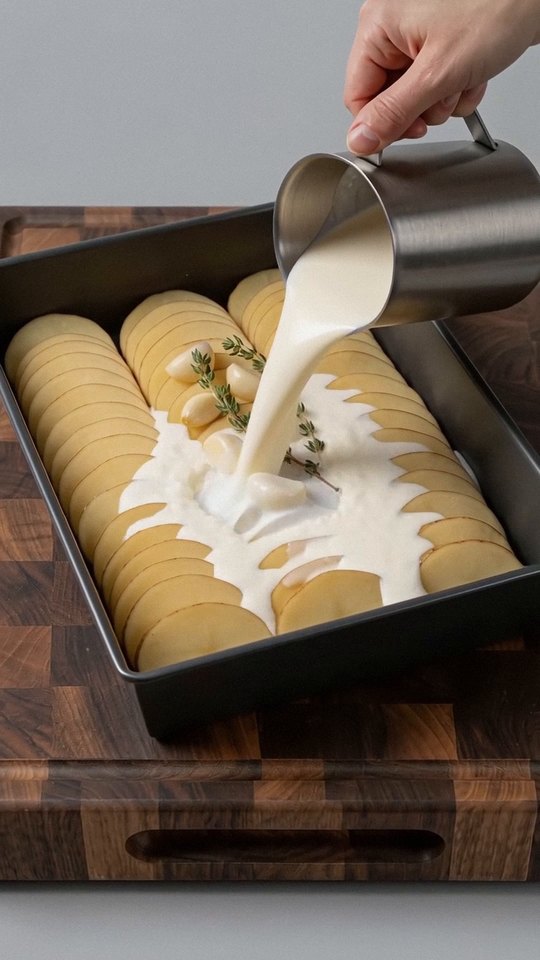
- Shingle 15 tight overlapping rows of thin potato rounds inside an open 10x14 baking pan with garlic cloves and fresh thyme sprigs, then pour warm heavy cream evenly over the layers.
- Bake uncovered in a glowing 375°F / 190°C oven until bubbling cream thickens and layers turn deeply toasted golden-amber on top.
- Set the hot baking pan on a walnut board and press the baked potato layers flat and compact under a nested second rectangular pan, then refrigerate until chilled completely firm into a dense 15-layer block.
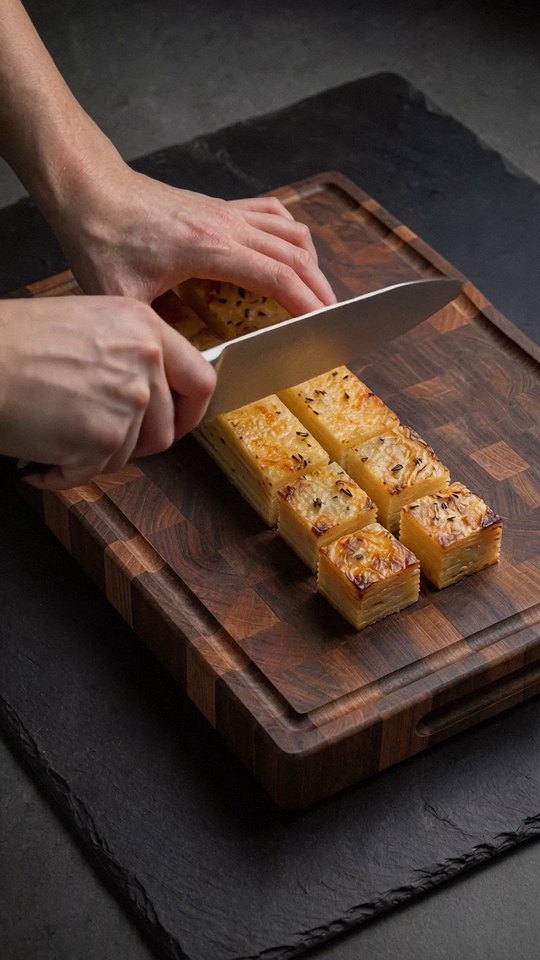
- Turn the pressed, chilled block out onto an oiled walnut board and cut cleanly with a sharp 8-inch chef knife into even 4.5 cm square 15-layer cubes.
- Fry the potato cubes in a seasoned cast-iron skillet in vigorously boiling nutty brown butter (beurre noisette), spooning foaming butter continuously over the crisp tops.
- Grate fine aged Parmigiano snow directly over the sizzling cubes, finish with flaky sea salt, and lift cleanly with tongs to serve.
Why do pressing, overnight chilling, and uniform cubes matter?
Pressing the hot baked potato pan compacts all fifteen tender layers into an even, void-free slab, and chilling overnight below 40 degrees Fahrenheit sets butterfat solid between baked layers so the sheets never fan apart under the blade. Cutting even 4.5 x 4.5 cm square cubes lets every vertical face caramelize uniformly in boiling brown butter without steaming crowded seams.
Check the matching French-touch pop-soul anthem on the GastroGen Karaoke player.
Frequently asked questions
Why chill the baked potato pan overnight before slicing cubes?
Chilling solidifies dairy fat and retrogrades potato starch between baked slices, transforming loose layers into a rigid golden-topped block that cuts cleanly into uniform 4.5 cm square cubes.
Why pour cream directly over layered slices instead of pre-mixing in a bowl?
Pouring warm cream over neatly shingled rounds inside the baking pan wets every horizontal gap cleanly without breaking delicate 1.5 mm potato coins before baking.
Why baste with actively boiling brown butter near the end instead of deep frying?
Shallow searing sets all crisp outer walls first, while actively boiling beurre noisette carries toasted milk solids, roasted garlic oils, and fresh thyme aroma directly across upper crisp layers without scorching.
Can the baked and chilled potato block be made ahead of dinner?
Yes. Hold the baked and chilled rectangular slab covered in the refrigerator for up to two days before slicing into equal square cubes and pan-searing to order.
AI-created visuals. Culinary inspiration, not a complete cooking guide.