 Boil & Glaze Ramen in Buldak Sauce: Simmer wavy ramen noodles for 2 minutes in a 3-quart tri-ply stainless saucepan, drain most water, and toss with the fiery Buldak chili glaze and 1 tbsp unsalted butter until glossy, then cool.
The story and science behind the dish · recipe above ↑
Spicy Ramen Cheesy Biscuits: Buldak Skillet Glaze, Laminated Buttermilk Stamping, and Pre-Bake Wash Physics
Why fold fiery Korean Buldak ramen curls directly into flaky cheddar-buttermilk biscuit dough?
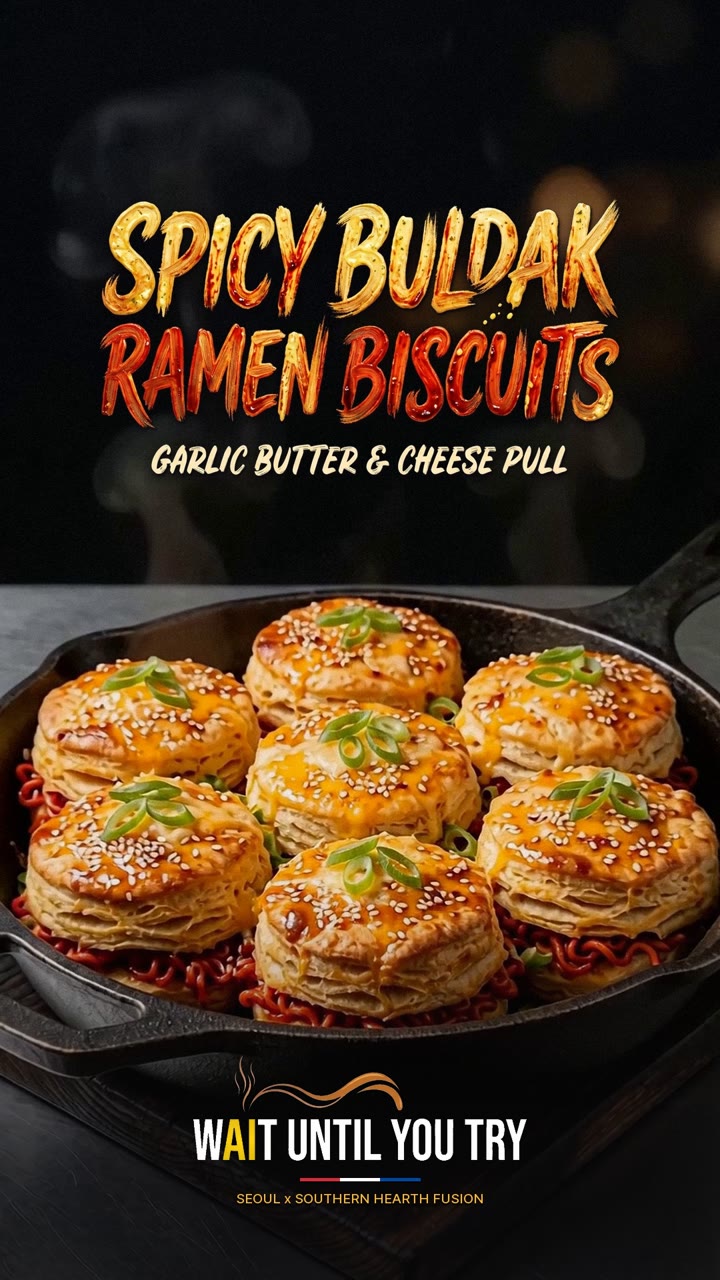
Spicy Ramen Cheesy Biscuits fold bite-sized curls of chili-simmered Korean ramen, sharp cheddar, and low-moisture whole-milk mozzarella directly into laminated buttermilk biscuit dough, stamp out neat 8-centimeter rounds, brush the raw tops with egg-butter wash and sesame seeds before baking at 220°C (425°F), and finish the risen 8.5-centimeter golden crowns with warm garlic-chive butter. When an 8-inch Damascus chef's knife slices straight through a warm biscuit on the walnut board, the crisp outer pastry layers shatter to reveal a steaming golden crumb studded with crimson ramen curls and melted cheese pockets.
The pairing works because of how dairy fat interacts with chili heat. Capsaicinoids in Korean fire-chicken seasoning bind tightly to TRPV1 heat receptors on the tongue, and plain water cannot rinse them away. Milkfat and casein proteins in sharp cheddar, mozzarella, and cultured buttermilk butter act as lipid solvents that round out the sharp burn while amplifying the roasted chili and toasted sesame aroma.
How did Seoul fire-noodle mashups meet Southern laminated biscuits?
The chili backbone comes from South Korea's buldak-bokkeummyeon (fire chicken stir-fried noodles), introduced by Samyang Foods in April 2012 after developer Kim Jung-soo saw diners spooning fiery red chili sauce onto grilled chicken in Seoul's Myeongdong district. Original packets register roughly 4,404 Scoville Heat Units on the Scoville scale, inspiring Korean convenience-store modisumer cooks to pair spicy ramyeon with melted cheddar, mozzarella, and butter.
In Korean-American home baking, those savory cheese-ramen flavors fit naturally inside North American buttermilk biscuits. Folding cooled, chili-glazed 2-to-3-centimeter ramen curls and shredded cheese into a 3.5-centimeter slab of cold laminated dough distributes chewy crimson noodles and cheese pockets across every flaky horizontal tier without creating a hollow or gummy dough wrapper.
Why simmer chopped ramen in a skillet before folding and stamping?
Tossing raw or plain boiled noodles into biscuit dough leaves bland flour pockets or loose water that ruins pastry lamination. Commercial instant noodles are steamed and flash-fried during manufacturing so their wheat starch is already partially gelatinized.
Boiling the crushed noodles 60 seconds shy of the package timer, chopping them into bite-sized 2-to-3-centimeter curls, and simmering them briefly in a 12-inch hexagonal hybrid skillet with 2 tablespoons of Buldak chili sauce, melted butter, and a handful of cheddar coats every curl in concentrated chili-butter emulsion. Once cooled for 5 minutes and folded into cold buttermilk dough, a sharp 8.0-centimeter (3.2-inch) round stainless steel biscuit cutter stamps clean vertical edges through the 3.5-centimeter slab so the cylinders rise straight upward in the oven instead of slumping sideways.
Why brush egg-butter wash on the raw dough cylinders before baking?
Pastry browning and herb aroma belong to two separate thermal stages. Under US dairy standards, low-moisture mozzarella (21 CFR 133.156) contains 45% to 52% moisture, and research from the Center for Dairy Research at the University of Wisconsin-Madison shows that cheddar and pasta filata curds melt cleanly between 55°C and 65°C while the surrounding biscuit crust needs surface proteins to brown at 220°C (425°F).
| Biscuit Stage & Component | Target Kitchen Dimension / State | Thermal Role Before & After 220°C (425°F) Bake | Result in Finished 8.5 cm Biscuit |
|---|---|---|---|
| Chopped Buldak ramen curls (2–3 cm) | Simmered in hex skillet with chili glaze & butter | Oil-lacquered starch resists drying inside dough | Tender crimson curls distributed through every bite |
| Sharp cheddar & low-moisture mozzarella (200 g) | Shredded from cold blocks, folded into dough + skillet | Melts into pockets without flooding dough seams | Warm cheesy pockets and crisp lacy cheese edges |
| Stamped raw dough cylinder | 8.0 cm (3.2 in) wide × 3.5 cm tall from round cutter | Uncrimped vertical walls let steam lift layers straight up | Rises to 8.5 cm wide × 5.5 cm tall flaky biscuit |
| Pre-bake egg-butter wash & sesame seeds | Brushed onto raw pale dough cylinders before baking | Egg proteins trigger Maillard browning; seeds toast in oven | Glossy golden-mahogany crust with adhered sesame seeds |
| Post-bake garlic-chive herb butter (40 g) | Brushed onto hot baked crowns after leaving the oven | Raw garlic and fresh chives warm gently without scorching | Fragrant buttery sheen over crisp flaky layers |
Brushing the egg-butter wash and sprinkling black and white sesame seeds onto the raw 8.0-centimeter dough cylinders on the parchment-lined aluminum half-sheet pan before they enter the oven lets mozzarella and cheddar bubble while egg proteins brown the crown and lock the seeds in place. Fresh garlic-chive butter is brushed on after baking so the delicate herb oils never burn at 220°C.
Why bake on a natural commercial aluminum half-sheet pan?
Dough loaded with cheese shreds and chili-glazed noodles carries extra density, so pan conductivity matters. Uncoated natural commercial aluminum conducts heat roughly 15 times faster than stainless steel and avoids the excessive radiant heat absorption of dark nonstick pans, which can char cheddar pockets on the biscuit base before the center flaky tiers finish rising.
Spacing six to eight stamped 8.0-centimeter cylinders across an 18-by-13-inch parchment-lined natural aluminum half-sheet pan gives hot oven air room to circulate around every cylinder wall during a 15-minute bake at 220°C (425°F).
How do you make Spicy Ramen Cheesy Biscuits step by step at home?
Ingredients (Makes 8 biscuits)
- 1 packet spicy Korean ramen noodles, boiled al dente and chopped into 2–3 cm curls
- 2 tbsp Korean spicy chicken chili seasoning sauce
- 200g sharp cheddar & low-moisture whole-milk mozzarella, shredded
- 550g chilled flaky buttermilk biscuit dough slab (3.5 cm thick)
- 2 tbsp egg-butter pre-bake wash & toasted black and white sesame seeds
- 40g warm melted garlic-chive herb butter
Method
- Simmer Ramen in Buldak Glaze & Cheddar: Boil wavy Korean ramen noodles 60 seconds shy of package directions, drain, chop into 2–3 cm curls, and toss in a 12-inch hex-hybrid skillet with 12-inch stainless scalloped locking tongs, 2 tbsp spicy Buldak chili sauce, a knob of butter, and a handful of shredded cheddar-mozzarella until glossy and coated, then cool briefly.
- Stamp 8 cm Rounds from Ramen-Cheddar Dough: Fold the cooled crimson ramen curls, remaining shredded cheddar and mozzarella, and sliced chives into chilled buttermilk biscuit dough, pat into a uniform 3.5 cm slab on a dark walnut butcher block, and stamp straight down without twisting using an 8.0 cm (3.2-inch) round stainless steel biscuit cutter.
- Brush Raw Dough Rounds Before Baking: Space the raw 8.0 cm × 3.5 cm pale dough cylinders on a parchment-lined 18" × 13" natural aluminum half-sheet pan, brush the raw tops with golden egg-butter wash using an angled heat-resistant silicone basting brush, and sprinkle with black and white sesame seeds before baking.
- Bake at 425°F to Tall Golden Flaky Layers: Bake at 220°C (425°F) for 14 to 16 minutes until the biscuits rise vertically into 8.5 cm wide × 5.5 cm tall golden-brown flaky layers with toasted sesame crowns and bubbling cheese vents.
- Finish Warm Biscuits with Garlic-Chive Butter: Transfer the hot baked 8.5 cm biscuits to the walnut butcher block, brush the crisp crowns with warm melted garlic-chive herb butter, and slice straight down with an 8-inch forged Damascus chef's knife to reveal the steaming cheddar-ramen crumb.
What common mistakes ruin flaky ramen-cheddar biscuits?
- Twisting the round biscuit cutter when stamping: Twisting seals the laminated edges shut and prevents vertical rise. Press the 8.0 cm stainless cutter straight down and lift straight up.
- Leaving noodles in long uncut strands: Long uncut strands tangle during stamping and pull out awkwardly. Chopping the glazed noodles into 2-to-3-centimeter curls keeps every bite uniform and realistic.
- Brushing egg wash after baking instead of before: Egg wash must bake in the oven to set into a golden crust and hold sesame seeds; save raw garlic-herb butter for the warm post-bake finish.
Frequently asked questions
Can I dial back the Buldak spice level for milder palates?
Yes. Simmer the chopped noodles with 1 tablespoon of the Buldak chili sauce plus 1 teaspoon of mild Korean gochujang and 1 teaspoon of honey so the curls keep their deep crimson color at half the heat.
Why chop the ramen into 2–3 cm curls before folding into the dough?
Bite-sized 2–3 cm curls fold evenly between the butter-flour layers without tearing the dough when stamped with an 8 cm round cutter, and they stay neatly distributed inside the flaky crumb when sliced.
Can I stamp the raw dough cylinders ahead of time?
Yes. Stamp the 8.0 cm rounds, arrange them on the parchment-lined aluminum half-sheet pan, cover, and chill for up to 4 hours. Brush with the egg-butter wash and sesame seeds right before sliding the pan into the 220°C (425°F) oven.
How do you reheat leftover biscuits so the outer crust stays flaky?
Skip the microwave and warm the biscuits on an aluminum sheet pan at 175°C (350°F) for 6 to 8 minutes, then brush lightly with melted garlic butter before serving.
Watch the short film
Watch the 15-second vertical short film at the top of this page, scored to the original K-Pop R&B funk track Too Hot To Behave. Browse our full recipe collection, send a dish request, and follow new episodes on YouTube, Instagram, and TikTok.
AI-created visuals. Culinary inspiration, not a complete cooking guide.