 Cube Marbled Prime Ribeye on End-Grain Walnut: Pat the boneless Prime ribeye steak completely dry and slice into uniform 1.5-inch cubes on the reversible end-grain American black walnut butcher block using the 8-inch forged 67-layer Damascus chef's knife.
The story and science behind the dish · recipe above ↑
Cast-Iron Garlic Butter Prime Steak Bites: Regional Origins, Kitchen Physics, and Step-by-Step Home Method
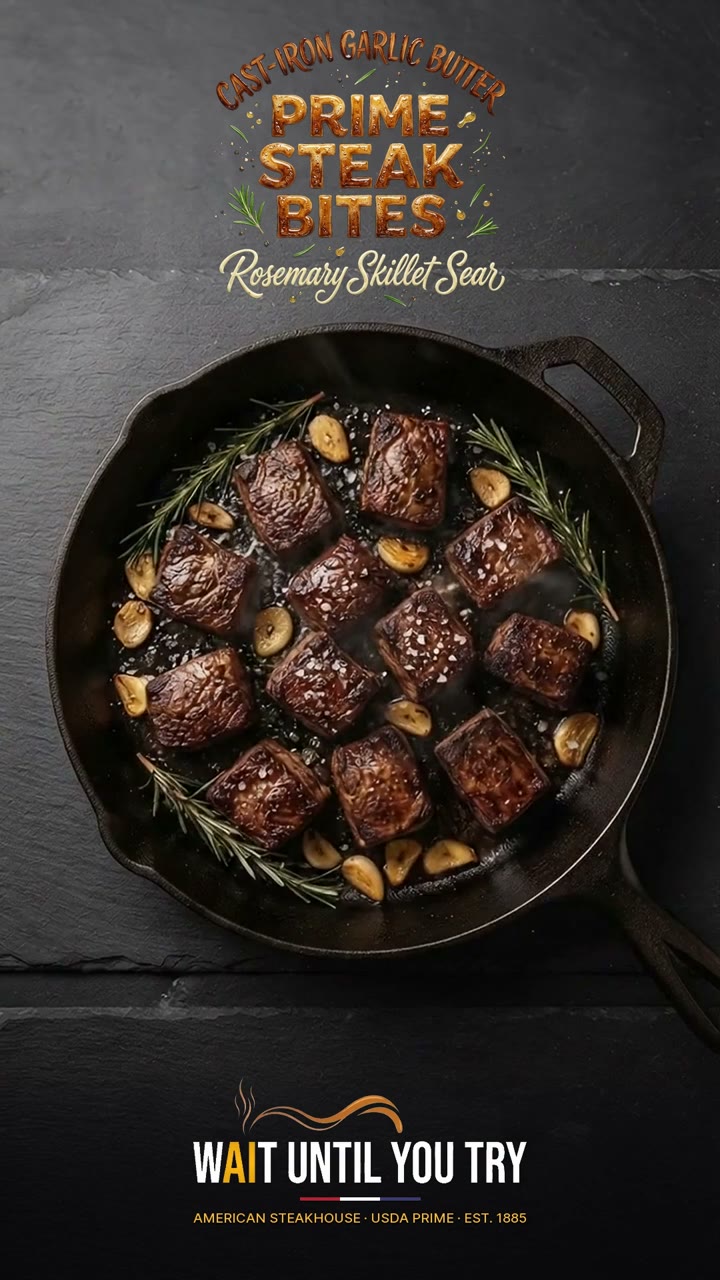
Cast-Iron Garlic Butter Prime Steak Bites is a signature preparation rooted in United States (PRIME RIBEYE CUBES • FOAMING ROSEMARY BUTTER • CRISPY GARLIC CHIPS) engineered around high-contrast textural layers, precise thermal or density control, and aromatic timing. Thick-cut Prime ribeye steak bites seared in a screaming-hot 12-inch seasoned cast-iron skillet until deeply mahogany, then basted in foaming cultured garlic-rosemary butter and crowned with golden crispy garlic chips. Grounded in Culinary Arts Reference and Food Science & Thermal Transfer, this method relies on disciplined mise en place and sequential staging so every component maintains its structural integrity from prep surface to final presentation.
Where does Cast-Iron Garlic Butter Prime Steak Bites come from and how did the culinary tradition develop?
Cutting thickly marbled Prime boneless ribeye into uniform 1.5-inch cubes doubles the caramelized surface area compared to a whole steak while keeping the center juicy medium-rare during a rapid two-minute cast-iron sear. Across contemporary kitchens and craft bars in United States, practitioners refined the ingredient ratios around high-heat thermal transfer, acid-fat balance, and visual contrast, building on principles documented in Culinary Arts Reference and Rib Eye Steak Cut & Marbling.
Three foundational principles define this approach at home:
- Sequential ingredient staging: Heavy foundational proteins, starches, or base spirits are conditioned first, establishing a stable thermal or specific-gravity floor before delicate emulsions, aromatics, or finishing floats enter the vessel.
- Controlled surface dehydration and Maillard kinetics: Removing excess free surface moisture prior to high-heat contact allows amino acids and reducing sugars to caramelize rapidly rather than steaming, a core mechanism detailed in Maillard Reaction & Browning Chemistry.
- Immediate service at peak sensory contrast: Adding whole crushed garlic cloves, fresh rosemary sprigs, and cold cultured butter only during the final 45 seconds of searing lets milk solids brown into nutty noisette foam without scorching the garlic. Serving immediately after the final garnish or flame kiss preserves the crisp boundary between contrasting layers.
What role does each ingredient play in the build?
Every measured component contributes a distinct physical, chemical, or aromatic function inside the finished preparation.
| Build Stage | Ingredient | Quantity | Culinary Function & Texture Role |
|---|---|---|---|
| Base foundation | boneless Prime ribeye steak (pat bone-dry & cut into 1.5-inch cubes) | 550 g | Primary structural body, density control, and thermal heat capacity |
| Base foundation | unsalted cultured butter & 1 tbsp high-smoke-point avocado oil | 45 g | Primary structural body, density control, and thermal heat capacity |
| Core thermal & flavor build | fresh garlic (4 lightly crushed in skin, 2 thinly sliced into chips) | 6 cloves | Mid-palate savory or botanical depth, Maillard browning, and viscosity balance |
| Core thermal & flavor build | fresh organic green rosemary & 4 sprigs fresh thyme | 3 sprigs | Mid-palate savory or botanical depth, Maillard browning, and viscosity balance |
| Finishing & aromatic garnish | flaky sea salt & 1 tsp coarsely cracked black pepper | 1.5 tsp | Volatile top-note aroma release, visual contrast, and crisp surface finish |
| Finishing & aromatic garnish | freshly chopped flat-leaf parsley & flaky finishing salt | 1 tbsp | Volatile top-note aroma release, visual contrast, and crisp surface finish |
How does food science explain the texture, color, and flavor balance?
From the perspective of Food Science & Thermal Transfer, the success of Cast-Iron Garlic Butter Prime Steak Bites depends on three measurable kitchen variables: surface-area geometry, thermal or specific-gravity stratification, and volatile aroma release.
- Uniform cut, portion, or dilution geometry: Preparing foundational components to uniform dimensions provides consistent heat conduction in cookware or steady chill and dilution across crystal ice blocks.
- Controlled Maillard browning, emulsion stability, or pH color shift: When proteins, starches, or botanical infusions encounter intense dry heat, sheared fat droplets, or citric acid adjustments, rapid molecular transformations occur at the boundary layer. Research in Maillard Reaction & Browning Chemistry and Cast-Iron Cookware Heat Retention explains why timing each addition within a narrow window prevents over-reduction or layer muddling.
- Volatile aromatic release at the summit: Introducing essential oils, toasted herbs, citrus zest, or freshly cracked spices during the final seconds keeps hydrophobic aroma compounds concentrated at the top of the serving vessel where the nose encounters them first, as explored in Beurre Noisette & Brown Butter Science.
Why do vessel selection and temperature conditioning matter before assembly?
Whether searing in heavy seasoned cast iron, baking on a raised wire airflow rack, tossing pasta in a wide tri-ply skillet, or building a layered cocktail in chilled cut-crystal glassware, pre-conditioning the vessel prevents thermal shock. As noted in Cast-Iron Cookware Heat Retention, an under-heated pan causes proteins to exude moisture and boil in their own juices, while an unchilled cocktail glass accelerates ice melt along the walls and disrupts density-layered floats.
Completing all knife work, spice blends, and liquid measurements before lighting the burner or lifting the jigger allows the cook or bartender to move smoothly from the opening sear or shake to the closing garnish without hesitation.
How do you make Cast-Iron Garlic Butter Prime Steak Bites step by step at home?
Ingredients (2 servings)
- 550 g boneless Prime ribeye steak (pat bone-dry & cut into 1.5-inch cubes)
- 45 g unsalted cultured butter & 1 tbsp high-smoke-point avocado oil
- 6 cloves fresh garlic (4 lightly crushed in skin, 2 thinly sliced into chips)
- 3 sprigs fresh organic green rosemary & 4 sprigs fresh thyme
- 1.5 tsp flaky sea salt & 1 tsp coarsely cracked black pepper
- 1 tbsp freshly chopped flat-leaf parsley & flaky finishing salt
Method
- Step 1: Cube Marbled Prime Ribeye on End-Grain Walnut: Pat the boneless Prime ribeye steak completely dry and slice into uniform 1.5-inch cubes on the reversible end-grain American black walnut butcher block using the 8-inch forged 67-layer Damascus chef's knife.
- Step 2: Crush Garlic & Season Generously: Press the flat side of the Damascus chef's knife over peeled garlic cloves to bruise them alongside fresh rosemary sprigs, then season the ribeye cubes evenly with flaky sea salt and cracked black pepper.
- Step 3: Sear in Screaming-Hot Seasoned Cast Iron: Heat avocado oil in the 12-inch pre-seasoned cast-iron skillet until shimmering, lay the steak cubes onto the iron floor with the 12-inch brushed stainless locking tongs with space between each piece, and sear undisturbed for 75 seconds.
- Step 4: Flip & Foam with Garlic-Rosemary Butter: Flip every cube onto its second face with the stainless locking tongs to reveal a deep mahogany Maillard crust, drop in cold cultured butter, crushed garlic, sliced garlic chips, and fresh rosemary, and toss for 45 seconds until the foaming brown butter glazes every bite.
What common mistakes hurt the texture and presentation of Cast-Iron Garlic Butter Prime Steak Bites?
- Overcrowding the cooking surface or rushing the layer pour: Packing pieces too tightly traps escaping steam and drops surface temperature, while pouring a float too quickly without breaking vertical momentum across the back of a spoon causes layers to mix prematurely.
- Skipping moisture control or dilution balance: Failing to pat proteins dry, salt-cure pork skin thoroughly, reserve starchy pasta water, or fine-strain fresh citrus juice introduces unwanted water or pulp that dulls the final gloss.
- Delaying service after the final garnish: Crispy crusts, molten cheese crowns, and aromatic smoke or citrus oils peak within the first ninety seconds after finishing. Plate or serve immediately once the final element lands.
Frequently asked questions
Can you prepare components of Cast-Iron Garlic Butter Prime Steak Bites ahead of time?
Yes. Foundational prep—such as cubing meat, scoring and dry-curing pork belly overnight in the refrigerator, simmering aromatics, or infusing botanical spirits and syrups—can be completed several hours ahead and stored in sealed containers. Hold back final high-heat searing, burrata slicing, citrus color activation, or butane torch finishing until right before serving.
How do you keep the layers and textures distinct when serving Cast-Iron Garlic Butter Prime Steak Bites?
Work from the heaviest, highest-density or highest-heat base components first and finish with delicate crowns, herb oils, or back-of-spoon floats at the very end, following the classical staging workflow described in Culinary Arts Reference.
What adjustments work if a specialty regional ingredient is unavailable?
Match the functional role—heat level, fat content, sugar brix density, or citrus acidity—rather than substituting at random. Principles of Rib Eye Steak Cut & Marbling emphasize preserving the core acid-to-fat or sugar-to-spirit ratio so the recipe retains its signature balance.
How should leftovers or prepped components be stored?
Because Cast-Iron Garlic Butter Prime Steak Bites relies on immediate thermal or visual contrast assembled at the moment of service, it is best enjoyed fresh. Store any uncombined base components separately from crisp toppings or garnishes in airtight containers in the refrigerator for up to 24 hours.
Watch the short film
Browse the complete recipe collection, send a recipe request, and follow our kitchen series on YouTube, Instagram, and TikTok.
AI-created visuals. Culinary inspiration, not a complete cooking guide.