The story and science behind the dish · recipe above ↑
Royal Amalfi Berry, Citrus and Pistachio Gelato Crystal Jar: Regional Origins, Kitchen Technique, and Step-by-Step Home Method
Royal Amalfi Berry, Citrus and Pistachio Gelato Crystal Jar is a signature preparation from Italy (AMALFI BERRIES, CITRUS JELLY & BRONTE PISTACHIO GELATO) built around distinct textural layers, practical temperature control, and balanced seasoning. Watch this 6-layer Royal Amalfi Berry, Citrus & Pistachio Gelato Crystal Jar levitate into a zero-gravity bullet-time exploded view and re-assemble piece by piece! Grounded in Gelato Culinary History and Pistachio Ice Cream Culinary History, this recipe relies on thorough mise en place and sequential cooking so every component holds its structure from stove to table.
Where does Royal Amalfi Berry, Citrus and Pistachio Gelato Crystal Jar come from and how did the tradition develop?
Along Italy's sun-drenched Amalfi Coast and Sorrento peninsula, master gelatieri craft monumental layered glass coppe that celebrate regional botanical jewels: fragrant coastal lemons turned into translucent citrus jellies, Sicilian blood oranges, wild berries, velvety mascarpone crema, and emerald Bronte pistachio gelato. Across regional kitchens in Italy, cooks refined the proportions around locally available produce, dairy, proteins, and aromatics, as noted in Gelato Culinary History and Food Science & Thermal Transfer.
Two structural principles define this regional approach:
- Sequential ingredient staging: Foundational components are prepared first, establishing a stable base before lighter liquids, emulsions, or temperature-sensitive toppings are added.
- Immediate service at peak contrast: True Bronte green pistachios from the volcanic slopes of Mount Etna are harvested only once every two years, giving authentic Italian pistachio gelato its prized emerald hue and intense roasted aroma! Serving immediately after the final garnish preserves the boundary between warm or chilled layers.
What role does each ingredient play in the build?
Every ingredient contributes a specific structural or aromatic function inside the finished dish.
| Build Stage | Ingredient | Quantity | Culinary Function & Texture Role |
|---|---|---|---|
| Base foundation | fresh Amalfi lemon juice (for lemon jelly) | 150 ml | Primary structure and moisture balance |
| Base foundation | water & 50 g caster sugar (for lemon jelly) | 70 ml | Primary structure and moisture balance |
| Core body & build | unflavored gelatin or 2 g agar-agar (for lemon jelly) | 6 g | Mid-palate body and contrasting texture |
| Core body & build | fresh wild strawberries (hulled and halved) | 120 g | Mid-palate body and contrasting texture |
| Core body & build | fresh plump blackberries | 100 g | Mid-palate body and contrasting texture |
| Core body & build | caster sugar & 1 tsp lemon juice (for berries) | 25 g | Mid-palate body and contrasting texture |
| Core body & build | green kiwis (peeled and sliced into 6mm wheels) | 2 ripe | Mid-palate body and contrasting texture |
| Core body & build | Sicilian blood oranges (cut into pith-free supremes) | 2 medium | Mid-palate body and contrasting texture |
| Finishing & garnish | cold mascarpone cheese | 120 g | Surface contrast and aroma release at service |
| Finishing & garnish | cold heavy cream, 25 g icing sugar & 1/2 vanilla bean | 80 ml | Surface contrast and aroma release at service |
How does food science explain the texture and flavor balance?
From the perspective of Pistachio Ice Cream Culinary History, the dish depends on three measurable kitchen variables: surface-area geometry, moisture migration, and fat-acid balance.
- Uniform cut and portion geometry: Preparing the foundational ingredients to consistent dimensions ensures even heat or liquid contact across every piece.
- Controlled moisture and solute exchange: When liquids, syrups, or dressings contact cut produce or cooked starches, osmotic pressure draws surface moisture outward while seasoning penetrates the outer layer. Studies in Sorbet Culinary History and Culinary Arts Reference show why timing the liquid addition preserves crisp cell walls and clean boundaries.
- Aromatic release at the summit: Adding volatile aromatics, dairy crowns, or crisp toppings at the final moment keeps aroma compounds concentrated at the top of the serving vessel.
Why do temperature and vessel preparation matter before assembly?
Whether served chilled in tall glassware or plated hot from the pan, pre-conditioning the serving vessel prevents thermal shock. As documented in Culinary Arts Reference, an unconditioned vessel accelerates melting or condensation along the walls, diluting sauces before service.
Preparing all sub-components and mise en place before assembly allows the cook to move cleanly from the base layer to the final garnish without rushing.
How do you make Royal Amalfi Berry, Citrus and Pistachio Gelato Crystal Jar step by step at home?
Ingredients (1 large wide-mouth crystal apothecary jar (16 oz / 480 ml))
- 150 ml fresh Amalfi lemon juice (for lemon jelly)
- 70 ml water & 50 g caster sugar (for lemon jelly)
- 6 g unflavored gelatin or 2 g agar-agar (for lemon jelly)
- 120 g fresh wild strawberries (hulled and halved)
- 100 g fresh plump blackberries
- 25 g caster sugar & 1 tsp lemon juice (for berries)
- 2 ripe green kiwis (peeled and sliced into 6mm wheels)
- 2 medium Sicilian blood oranges (cut into pith-free supremes)
- 120 g cold mascarpone cheese
- 80 ml cold heavy cream, 25 g icing sugar & 1/2 vanilla bean
- 2 scoops artisanal Bronte pistachio gelato (120 g)
- 2 scoops crimson raspberry sorbetto (120 g)
- 60 g finely crushed ice
- 25 g toasted crushed Bronte pistachios, 2 wafers & mint
Method
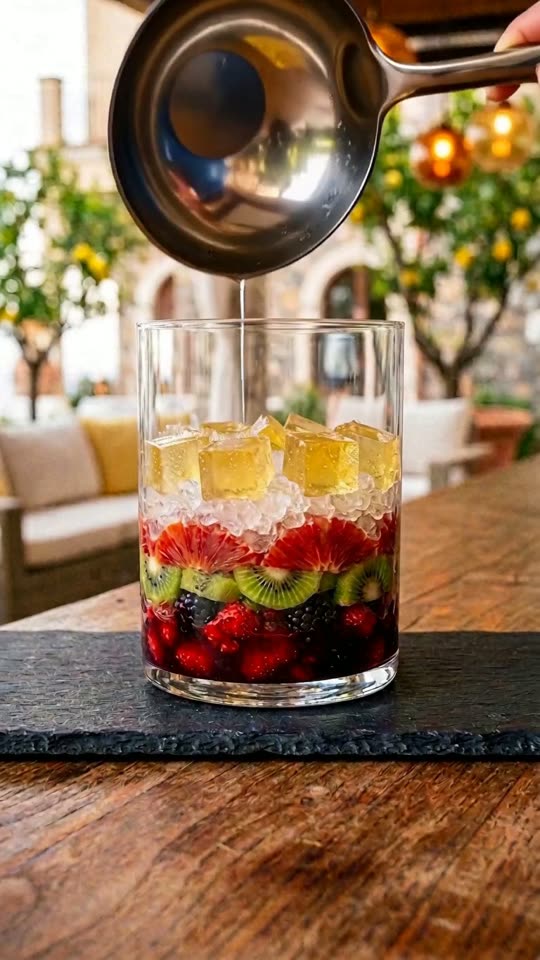
- Step 1: Bloom & Set the Amalfi Lemon Jelly Cubes: Sprinkle 6g unflavored gelatin (or 2g agar-agar powder) over 30ml cold water in a small bowl and let bloom for 5 minutes. In a small saucepan, warm 150ml fresh Amalfi lemon juice, 40ml water, 50g caster sugar, and 2 strips of yellow lemon peel over low heat until the sugar dissolves (if using agar, boil 90 seconds; if using gelatin, keep below 65°C / 150°F). Off the heat, stir in the bloomed gelatin until clear, strain into a shallow square dish (1.5 cm deep), refrigerate for 2 hours until firm, and cut into 1.5 cm sparkling cubes.
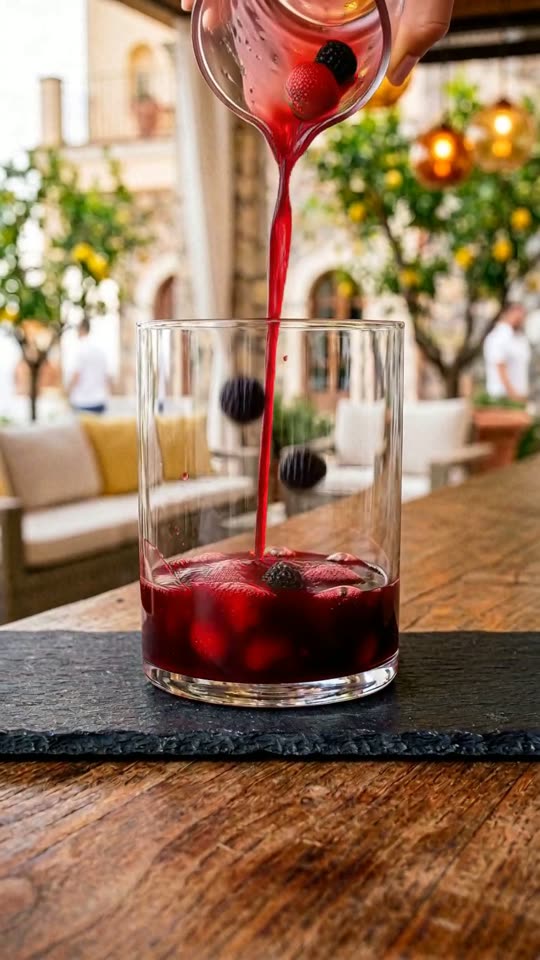
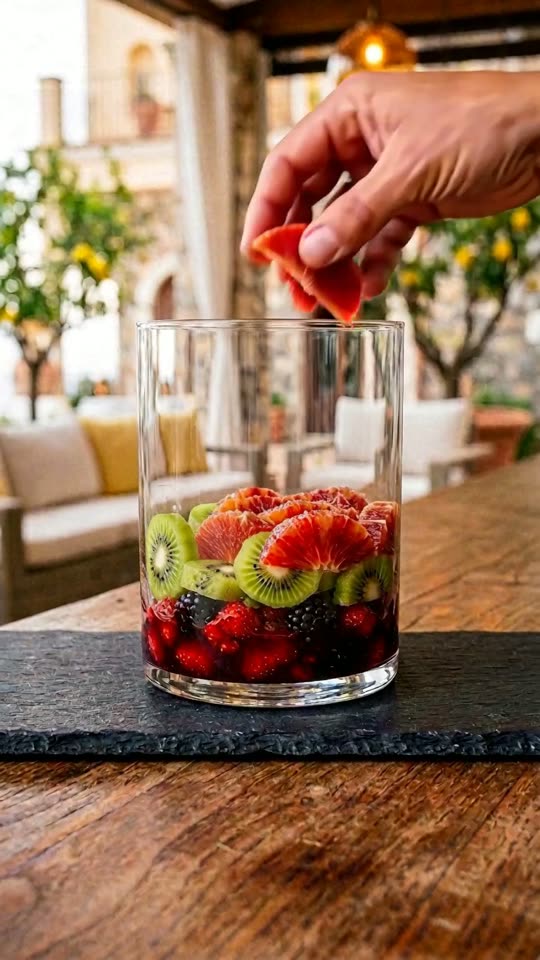
- Step 2: Macerate the Berries & Cut the Blood Orange Supremes: Combine the 120g halved strawberries and 100g blackberries in a bowl with 25g caster sugar and 1 tsp lemon juice; toss gently and macerate for 20 minutes until a glossy natural ruby syrup forms. Meanwhile, slice the peeled kiwis into 6mm wheels, and use a sharp paring knife to peel the 2 blood oranges down to the flesh and slice between the membranes to release clean, pith-free citrus supremes.
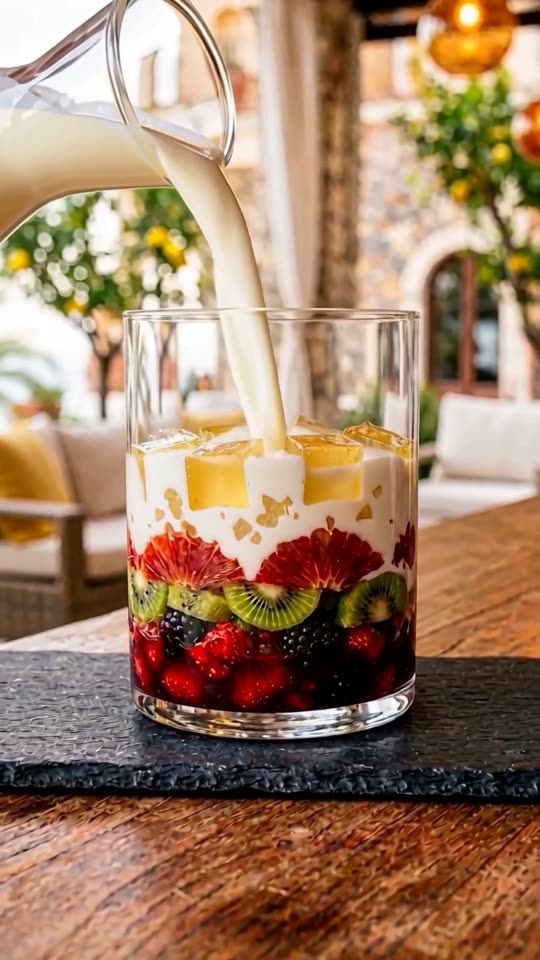
- Step 3: Whisk the Pourable Vanilla Bean Mascarpone Cream: In a chilled mixing bowl, whisk the 120g cold mascarpone, 80ml cold heavy cream, 25g icing sugar, and the scraped seeds of 1/2 vanilla bean for 60 to 90 seconds just until smooth, velvety, and pourable like thick heavy cream (stop before stiff peaks form so it ribbons through the fruit). Transfer to a small pitcher and chill.
- Step 4: Spoon the Macerated Ruby Berry Foundation: Chill two wide-mouth glass coupe jars in the freezer for 10 minutes. Spoon the macerated strawberries, blackberries, and 2 tablespoons of their natural ruby juice into the base of each glass.
- Step 5: Arrange the Kiwi Wheels & Blood Orange Supremes: Press the emerald kiwi rounds upright against the inside glass walls and nestle the blood orange supremes over the berry layer so the citrus and kiwi bands show clearly from the outside.
- Step 6: Tuck in the Amalfi Lemon Jelly Cubes & Crushed Ice: Add 4 to 5 chilled Amalfi lemon jelly cubes per glass along with 2 tablespoons of finely crushed ice to keep the fruit crisp and brace the upper layers.
- Step 7: Pour the Chilled Vanilla Mascarpone Cream: Slowly pour the chilled vanilla bean mascarpone cream around the lemon jelly cubes and fruit so it settles in ivory ribbons without submerging the top.
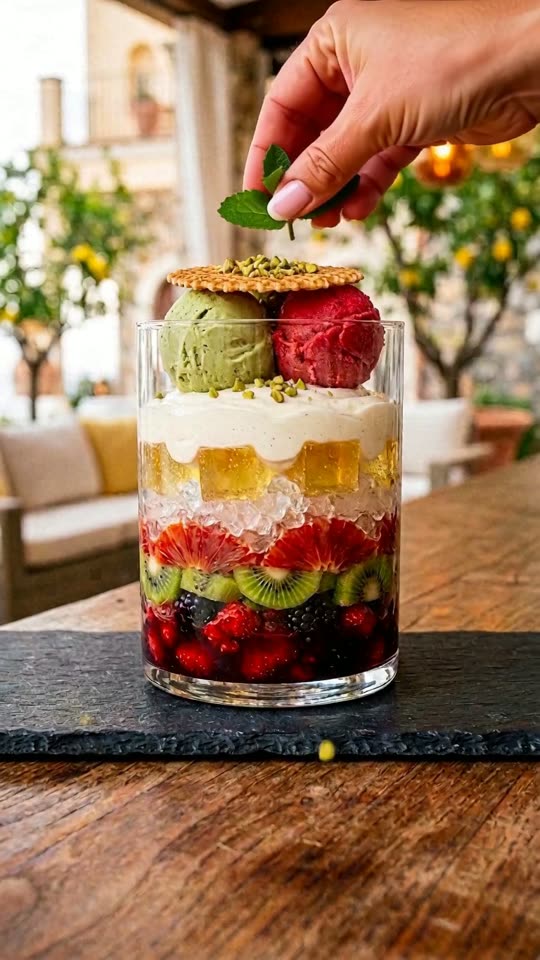
- Step 8: Crown with Pistachio Gelato, Raspberry Sorbetto & Crunch: Place one firm scoop of Bronte pistachio gelato on the left and one scoop of raspberry sorbetto on the right. Tuck a crisp waffle wafer disk behind the scoops, scatter with toasted crushed pistachios and a fresh mint sprig, and serve immediately with a long spoon.
What common mistakes hurt the texture of Royal Amalfi Berry, Citrus and Pistachio Gelato Crystal Jar?
- Inconsistent knife work or portioning: Unevenly sized pieces disrupt cooking times and mouthfeel. Cut or portion components uniformly before heating the pan or assembling.
- Dressing or saucing too early: Combining the liquid bath or finishing drizzle too early allows moisture migration to soften crisp garnishes. Keep wet and dry components separate until assembly.
- Skipping vessel temperature prep: Match the serving vessel temperature to the dish so cold elements stay frosty and warm elements retain their heat.
Frequently asked questions
Can you prepare the components of Royal Amalfi Berry, Citrus and Pistachio Gelato Crystal Jar ahead of time?
Yes. Most foundational components and sauces can be portioned, diced, or simmered several hours in advance and refrigerated in airtight containers. Hold back delicate fruits, crisp batters or wafers, herbs, and dairy crowns until right before serving.
How do you keep the textures distinct when serving Royal Amalfi Berry, Citrus and Pistachio Gelato Crystal Jar?
Prepare sauces, custards, or garnishes first, then build from the heaviest foundational ingredients at the base toward the lightest toppings at the summit as practiced in Gelato Culinary History.
What adjustments work if a specialty regional ingredient is unavailable?
Match the functional profile—acidity, sweetness, fat content, and crunch—rather than substituting at random. Principles of Food Science & Thermal Transfer emphasize balancing the primary acid and fat ratios so the dish retains its regional character.
How should leftovers be stored?
Because the dish relies on contrasting textures assembled right before service, it is best enjoyed fresh. Store leftover base components separately from crisp garnishes in a sealed container in the refrigerator for up to 24 hours.
Watch the short film
Browse the complete recipe collection, send a recipe request, and follow our kitchen series on YouTube, Instagram, and TikTok.
AI-created visuals. Culinary inspiration, not a complete cooking guide.