The story and science behind the dish · recipe above ↑
Authentic Mexican Street Mangonada: Paletería Mango Slush, Homemade Chamoy & The Sweet-Sour-Spicy Balance
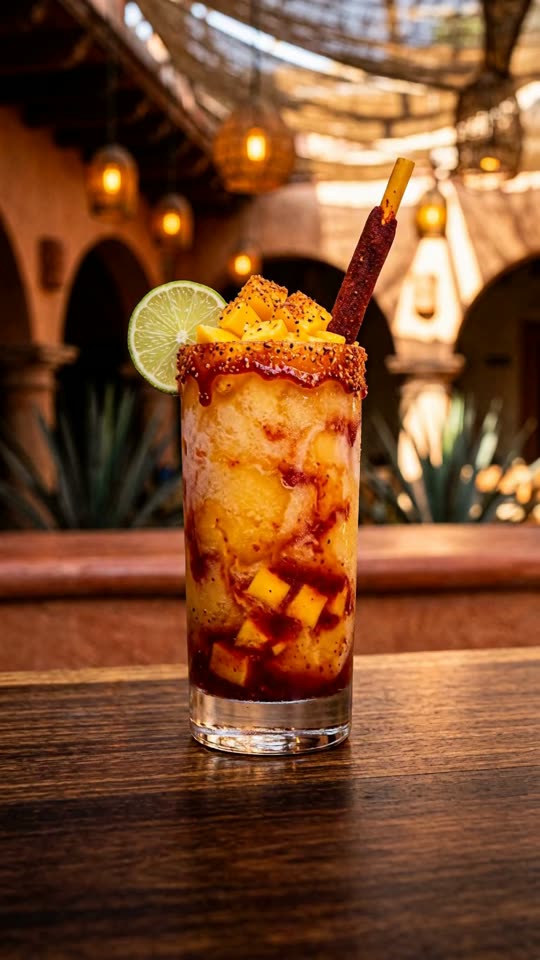
Order a mangonada (also called a chamoyada) from a neighborhood paletería or fruit cart in Mexico City, Guadalajara, or Michoacán and you receive a towering cup of golden frozen mango swirled with deep crimson chamoy, encrusted with fiery Tajín seasoning), heaped with fresh diced mango, and speared with a chewy chili-coated tamarind candy straw (banderilla). What separates an authentic Mexican street mangonada from a watery mango smoothie is how the frozen base is built: real paleteros freeze two-thirds of the ripe mango cubes solid beforehand so the blender turns the fruit itself into a dense, velvety nieve de mango (mango sorbet slush) with only a handful of ice required.
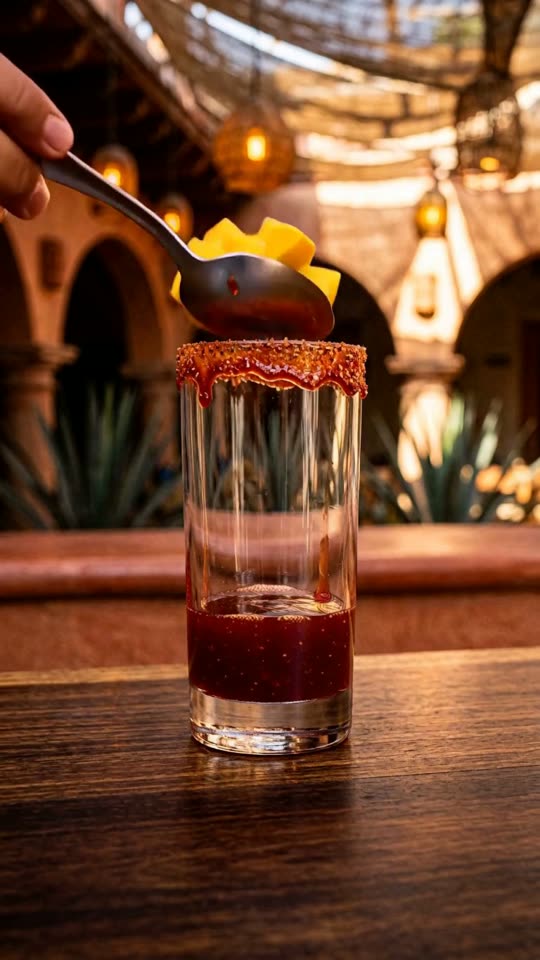
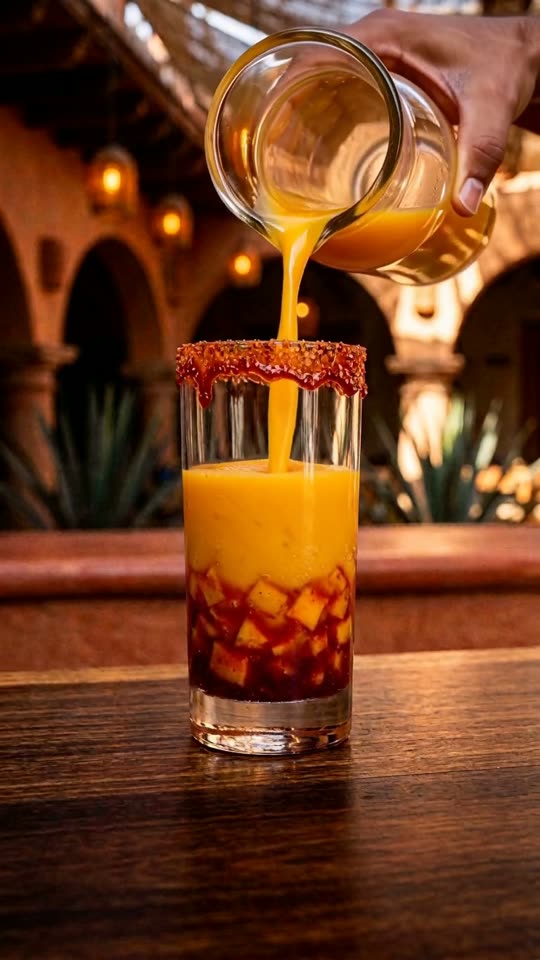
While our short film highlights the final rimming, swirling, and mango crowning, this kitchen guide explains how to choose and freeze the right mango cultivars, how to simmer homemade apricot-hibiscus chamoy from scratch in fifteen minutes (or season store-bought chamoy), and how to build the seven-step street-style glass at home.
Where did the Mexican mangonada and chamoy tradition come from?
The mangonada belongs to the Mexican antojito tradition of pairing ripe tropical fruit with salt, lime juice, and dried chili peppers—a flavor triad that activates sweet, sour, salty, and capsaicin receptors simultaneously. Its signature ruby-red sauce, chamoy, traces its roots to pickled Asian stone fruits (suanmeitang and Japanese umeboshi / Chinese see mui salted plums) introduced to Mexico via historic Pacific trade routes and nineteenth- and twentieth-century migration, as documented in the history of Mexican cuisine.
Mexican confectioners adapted the salted-fruit technique using native ingredients: dried apricots, prunes, or hawthorn (tejocote), tart crimson jamaica (hibiscus) calyces), dried guajillo or ancho chilies, salt, and lime juice. Combined with frozen golden mango sorbet in regional neverías and paleterías, the chamoy-and-mango cup became one of North America's most beloved frozen street desserts.
Why must you freeze the mango chunks instead of blending fresh mango with lots of ice?
If you blend room-temperature mango with three cups of ice cubes, the melting ice dilutes the mango's natural sugars and pectin, producing an icy slush that separates into clear water at the bottom of the glass within three minutes. Freezing 500 grams of diced ripe mango on a parchment-lined tray for two hours solves the problem through fruit-fiber cryogenics:
- Pectin & Fiber Emulsification: Mango flesh—especially the small, tear-drop-shaped golden Ataulfo (Champagne / honey) mango—is exceptionally low in stringy cellulose fibers and high in natural pectin. When frozen mango cubes are pulverized in a blender with cold mango nectar and fresh lime juice, the fruit cell walls shear into a creamy, spoonable soft-serve sorbet.
- Viscosity Matching with Chamoy: Because the frozen mango base is thick and frosty rather than watery, ribbons of ruby chamoy drizzled along the inside wall of the chilled glass cling in sharp sunset bands instead of sinking straight to the bottom.
- Reserved Fresh Mango Contrast: Holding back one-third of the diced mango unfrozen in the refrigerator gives you juicy, tender fruit cubes to pile on top of the frozen slush for a two-texture contrast in every spoonful.
How do the five core flavor layers interact inside the glass?
Every element in a street-style mangonada balances a specific taste dimension:
| Component | Quantity (2 Glasses) | Flavor Profile | Culinary Function in the Build |
|---|---|---|---|
| Frozen Ataulfo / Kent Mango Cubes | 500 g frozen + 250 g chilled fresh | Rich tropical sweetness, floral aroma | Forms the non-watery soft-serve sorbet body and fresh diced crown |
| Chilled Mango Nectar & Lime Juice | 150 ml nectar + 30 ml fresh lime juice | Bright sweet-tart acidity | Lubricates the blender blades so frozen fruit spins into smooth slush |
| Red Chamoy Sauce | 120 ml (store-bought or homemade apricot-hibiscus) | Salty, sour, sweet, mild chili warmth | Coats the glass rim and creates dramatic crimson swirls along the glass |
| Tajín Clásico Seasoning | 3 tbsp (dehydrated lime, sea salt, mild chili blend) | Brisk citrus saltiness and earthy heat | Forms the crunchy rim crust and amplifies mango sweetness |
| Tamarind-Chili Straw (Banderilla) | 2 thick tamarind-paste coated straws | Tangy, chewy tamarind pulp and chili | Functions as both an edible stirrer and functional drinking straw |
How do you make homemade chamoy in 15 minutes if you don't have a bottle on hand?
If you cannot find bottled Mexican chamoy at your local market—or want a preservative-free version without artificial red dye—you can simmer an authentic fruit-based chamoy in one small saucepan:
- Combine 100g dried apricots, 40g dried hibiscus flowers (flor de jamaica), 35g pitted prunes or raisins, 1 stemmed and seeded dried guajillo chili, and 350ml water in a saucepan.
- Bring to a boil, reduce heat to low, cover, and simmer for 12 minutes until the dried fruit is plump and soft and the hibiscus turns the liquid deep ruby red.
- Discard the guajillo chili (or leave half in for extra heat), transfer the fruit and cooking liquid to a blender with 2 tablespoons granulated sugar, 1 tablespoon Tajín Clásico, 1/2 teaspoon sea salt, and 60ml fresh lime juice, and blend on high until glossy and smooth. Chill completely before swirling into your glass.
How do you make an Authentic Mexican Street Mangonada step by step?
- Dice the Ripe Mangoes & Freeze Two-Thirds for the Slush: Peel 3 large ripe Ataulfo (honey) or Kent mangoes (about 750g flesh total) and cut into neat 1.2 cm cubes. Spread 500g of the mango cubes in a single layer on a parchment-lined tray and freeze for at least 2 hours until solid (using frozen mango chunks instead of mostly ice cubes produces a velvety, non-watery Mexican paletería slush), and keep the remaining 250g diced mango chilled in the fridge for the top.
- Season the Chamoy Sauce (or Simmer Homemade Chamoy): Stir 120ml Mexican chamoy sauce with 1 tbsp fresh lime juice and 1 tsp Tajín Clásico in a squeeze bottle or small pitcher so it pours in glossy ribbons. (Or prepare the 15-minute homemade apricot-hibiscus chamoy above and chill.)
- Rim Chilled Glasses with Chamoy & Tajín: Pour 2 tablespoons of chamoy onto one small saucer and 3 tablespoons of Tajín chili-lime seasoning onto a second saucer. Dip the rim of two chilled tall highball glasses 5mm deep into the chamoy, then roll immediately in the Tajín to form a thick spicy-salty crust.
- Blend the Thick Frozen Mango Slush (Nieve de Mango): Combine the 500g frozen mango cubes, 150ml chilled mango nectar, 30ml fresh lime juice, 1 tbsp agave syrup (if your mangoes are tart), and 80g crushed ice in a high-powered blender. Blend on high using the tamper for 45 seconds until thick, frosty, and spoonable like soft-serve sorbet.
- Spoon the Base Slush & Swirl the Inner Walls with Chamoy: Spoon a thick 4 cm layer of the frozen golden mango slush into the bottom of each rimmed glass, then drizzle 1.5 tablespoons of chamoy and a pinch of Tajín around the inside glass wall.
- Build the Second Mango Slush & Chamoy Tier: Add a second generous layer of frozen mango slush and a splash of chilled mango nectar to reach just below the rim, swirling another ribbon of ruby chamoy along the glass so distinct sunset bands show through the crystal.
- Crown with Fresh Mango Cubes & Tamarind Straw: Heap the reserved 250g chilled fresh mango cubes into a tall mound on top, drizzle with a final thread of chamoy and dust of Tajín, perch a lime wheel on the rim, and push a tamarind-chili candy straw (banderilla) deep into the glass.
Frequently asked questions
Which mango variety makes the least stringy mangonada?
Small yellow Ataulfo mangoes (often labeled Honey or Champagne mangoes) have virtually zero fibrous strings and a rich, custardy flesh. If using larger red-and-green mangoes, choose Kent or Keitt varieties over Tommy Atkins, which tends to be more fibrous near the pit.
Is a mangonada very spicy?
No. Both traditional chamoy and Tajín Clásico are formulated with mild dried chilies (such as ancho, guajillo, and pasilla) that emphasize tangy lime, salt, and fruity warmth rather than intense capsaicin burn. If you want sharper heat, add a dash of Valentina hot sauce or a pinch of cayenne to your chamoy swirl.
Can I use store-bought mango sorbet instead of blending frozen mango?
Yes. If you want to assemble mangonadas in five minutes without a blender, let a pint of good-quality mango sorbet sit on the counter for 5 minutes until slightly softened, then layer big spoonfuls of sorbet with chamoy, Tajín, and fresh diced mango cubes in chilled glasses.
Can you turn a mangonada into an adult cocktail?
While traditional street mangonadas are completely non-alcoholic, you can blend 60ml (2 oz) of 100% blue agave blanco tequila or smoky mezcal into the frozen mango slush, or pour a 30ml float into the center well under the fresh mango crown.
Watch the short film
Browse the complete recipe collection, send a recipe request, and follow our kitchen series on YouTube, Instagram, and TikTok.
AI-created visuals. Culinary inspiration, not a complete cooking guide.