The story and science behind the dish · recipe above ↑
Royal Filipino Halo-Halo Supreme: Why the Preserves Go Under the Ice, How Milk Percolates, and the Full Layered Build
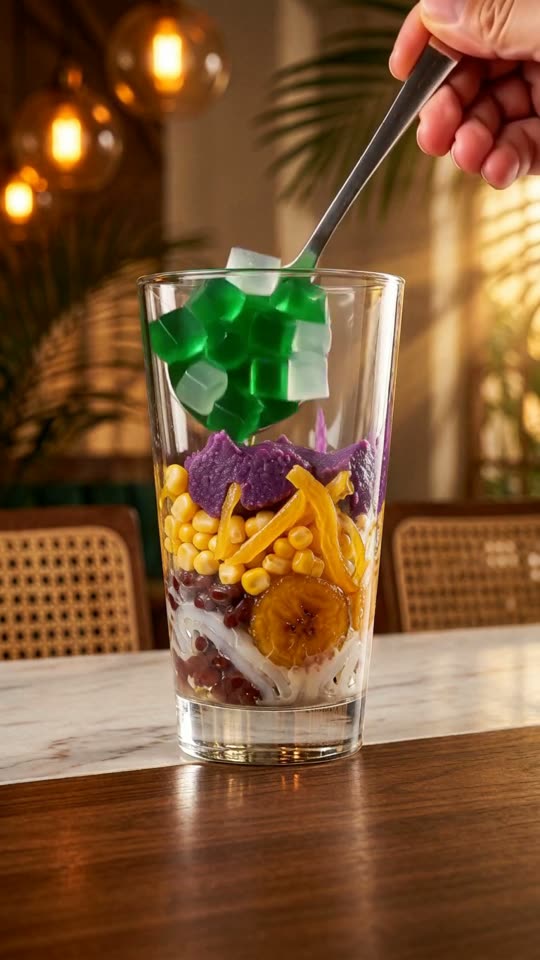
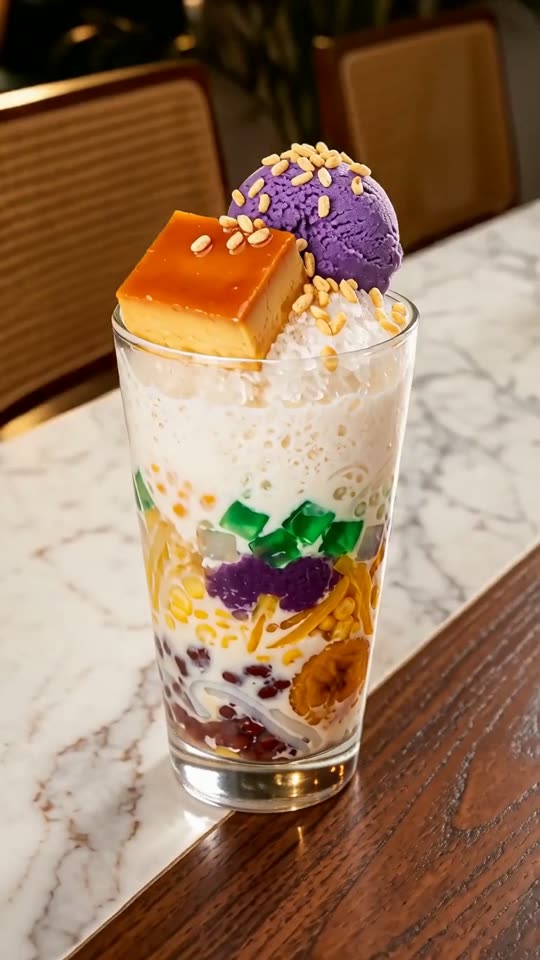
Royal Filipino Halo-Halo Supreme is the Philippines' layered shaved-ice sundae built from bottom to top in a tall clear glass: sweetened tropical fruits, beans, and coconut gels at the base, a packed dome of snow-fine shaved ice soaked with chilled evaporated milk in the middle, and a crown of caramel leche flan, purple ube ice cream, and toasted pinipig rice flakes on top. The name halo-halo (spelled haluhalò by the Commission on the Filipino Language) is a reduplication of the Tagalog verb halò, meaning "to mix," describing how the diner eventually stirs the chilled layers together with a long spoon.
Unlike syrupy snow cones where flavored liquid sits on bare ice, a traditional Manila halo-halo relies on density and temperature contrast. Heavy syrup-cured preserves rest at the bottom of the glass so they do not crush the delicate shaved ice, while cold evaporated milk percolates downward through the porous ice crystals to link the custard crown with the fruit base below.
Where did halo-halo actually come from?
Documented culinary history traces halo-halo to pre-war Japanese immigrants in Manila who sold kakigōri—shaved ice topped with sweet boiled beans and milk. In the 1920s and 1930s, Japanese stalls inside Quinta Market in Quiapo, Manila operated directly across from the Insular Ice Plant, which the American colonial administration had constructed in 1902 as the city's primary industrial ice supply after earlier 19th-century block-ice shipments from Wenham Lake.
Local adaptation transformed the Japanese template in two distinct ways:
- From single-bean monggo con hielo to multi-fruit preserves: Early Manila vendors adapted Spanish-Filipino maíz con hielo (sweet corn with ice and milk) into monggo con hielo or mongo-ya, substituting local mung beans simmered in syrup (minatamís na monggo) for Japanese red azuki beans. Over subsequent decades, Filipino cooks added native sweetened plantains, jackfruit, coconut sport, and palm gels.
- Inverting the architecture: While Japanese kakigōri places toppings over the ice, Filipino makers moved the dense, syrupy fruits and beans underneath the shaved ice and reserved the top dome for leche flan, ube, and crisp toasted grains.
What does each layer do inside the glass?
Every component in a classic halo-halo contributes a distinct texture—starchy, fibrous, gelatinous, creamy, or crisp—so that no two spoonfuls taste identical after mixing.
| Layer Position | Ingredient | Botanical / Culinary Origin | Texture & Role in the Glass |
|---|---|---|---|
| Bottom base | Caramelized sabá bananas (minatamís na saging) | Triploid sabá cooking banana (Musa acuminata × balbisiana, ABB Group) | Dense, starchy flesh holds firm angles in brown-sugar syrup without turning mushy |
| Bottom base | Sweetened jackfruit (langkâ) & red mung beans | Ripe Artocarpus heterophyllus strips and syrup-simmered legumes | Floral tropical aroma and earthy starch that anchor the bottom third of the glass |
| Lower middle | Macapuno (coconut sport strings) | Recessive coconut endosperm where inactive α-D-galactosidase leaves soft jelly flesh | Silky, rich coconut strands that float upward once chilled milk enters |
| Lower middle | Nata de coco cubes | Coconut water fermented with Komagataeibacter xylinus microbial cellulose | Firm, translucent chew that contrasts with soft custard and melting ice |
| Upper body | Finely shaved ice + chilled evaporated milk | Snow-shaved water ice and unsweetened concentrated dairy | Porous thermal matrix; cold milk coats ice crystals and tempers the sweet syrup base |
| Summit crown | Caramel leche flan, ube ice cream & pinipig | Steamed egg-yolk custard, purple yam (Dioscorea alata), and pounded green glutinous rice | Velvety custard, earthy-sweet purple yam cream, and toasted nutty crunch on top |
How did Filipino food science shape macapuno and nata de coco?
Two of the signature textures inside the glass exist because of 20th-century Philippine agricultural and microbiological research:
- Embryo-rescued macapuno: First described scientifically in 1931 by botanist Edwin Copeland from specimens in Laguna, macapuno coconuts contain a mutant endosperm that fills the shell with translucent, jelly-like meat instead of liquid water. Because wild macapuno nuts cannot germinate on their own, they occurred in only 2% to 21% of nuts on bearing palms until the 1960s, when Filipina plant physiologist Emerita V. De Guzman at the University of the Philippines developed in vitro embryo rescue culture, lifting yields to 75%–100%.
- Microbial cellulose nata de coco: Invented in 1949 by Filipina chemist Teódula Kalaw África at the National Coconut Corporation as a year-round replacement for seasonal pineapple nata de piña, nata de coco is formed when Komagataeibacter xylinus spins coconut water sugars into crisp, translucent cubes that keep their bounce even when submerged in ice and milk.
Why must the evaporated milk and glasses be thoroughly chilled?
Shaved ice has an enormous surface-area-to-volume ratio compared with cubed ice. If room-temperature evaporated milk or warm syrup preserves touch snow-fine shaved ice, the ice lattice collapses immediately into watery slush before the toppings can be seated on the dome.
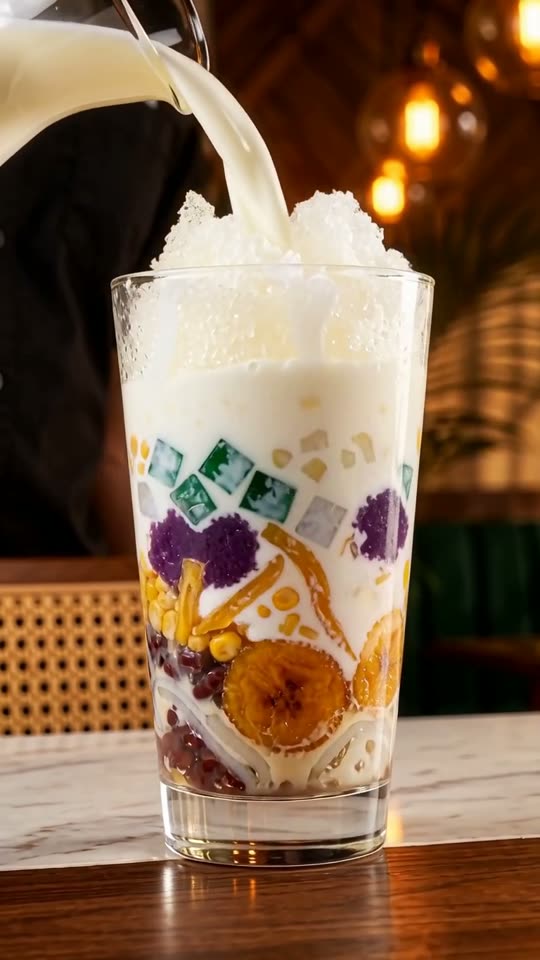
Chilling the tall parfait glasses, the fruit preserves, and the evaporated milk to refrigerator temperature (4°C / 39°F) before assembly preserves the air pockets between shaved ice crystals. When cold evaporated milk is poured in a slow stream at the center of the dome, it percolates downward through the ice without melting the summit, leaving a firm frosty shelf capable of supporting both a thick slice of leche flan and a full scoop of ube ice cream.
How do you build Royal Filipino Halo-Halo Supreme step by step?
Ingredients (Serves 2 tall glasses)
- 500 g finely shaved ice (snow-soft texture)
- 240 ml evaporated milk, well chilled
- 80 g sweetened caramelized sabá bananas (minatamís na saging)
- 60 g sweetened ripe jackfruit strips (langkâ)
- 60 g macapuno (sweetened tender young coconut sport strings)
- 60 g nata de coco (translucent coconut gel cubes, drained of excess syrup)
- 60 g sweetened red mung beans
- 2 thick slices (80 g) traditional caramel leche flan
- 2 large scoops (160 g) royal purple yam (ube) ice cream
- 20 g toasted pinipig (crispy pounded green glutinous rice flakes)
Method
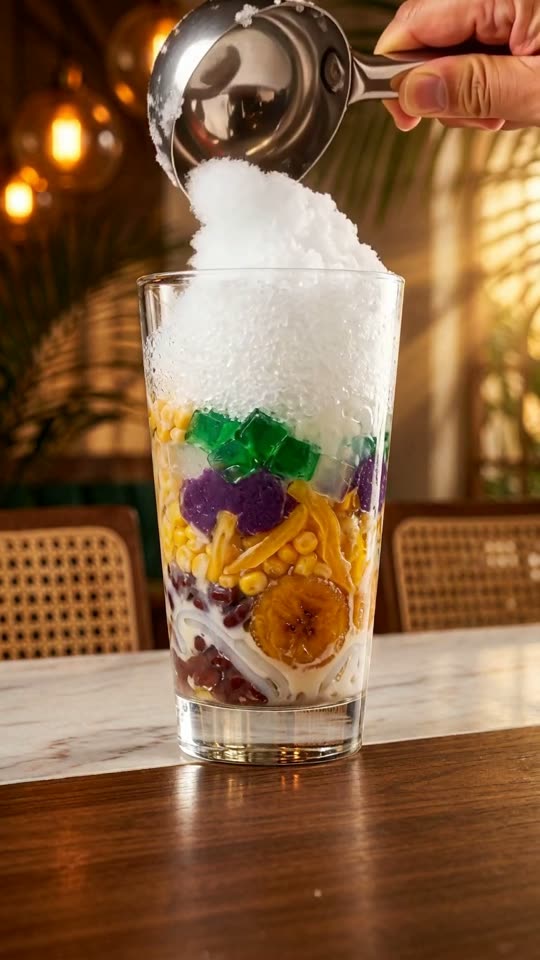
- Layer the fruit and bean base: In two tall, chilled clear parfait glasses, spoon the sweetened preserves into the bottom third of each glass in distinct layers: red mung beans, macapuno coconut strings, caramelized sabá banana slices, ripe jackfruit strips, and drained nata de coco cubes.
- Pack the shaved ice dome: Mound finely shaved, snow-soft ice over the fruit base until it fills the upper half of the glass and forms a smooth rounded dome just at the rim.
- Percolate the chilled evaporated milk: Slowly pour the ice-cold evaporated milk into the center of the shaved ice dome, allowing the dairy to trickle down through the ice crystals and swirl around the colorful preserves below.
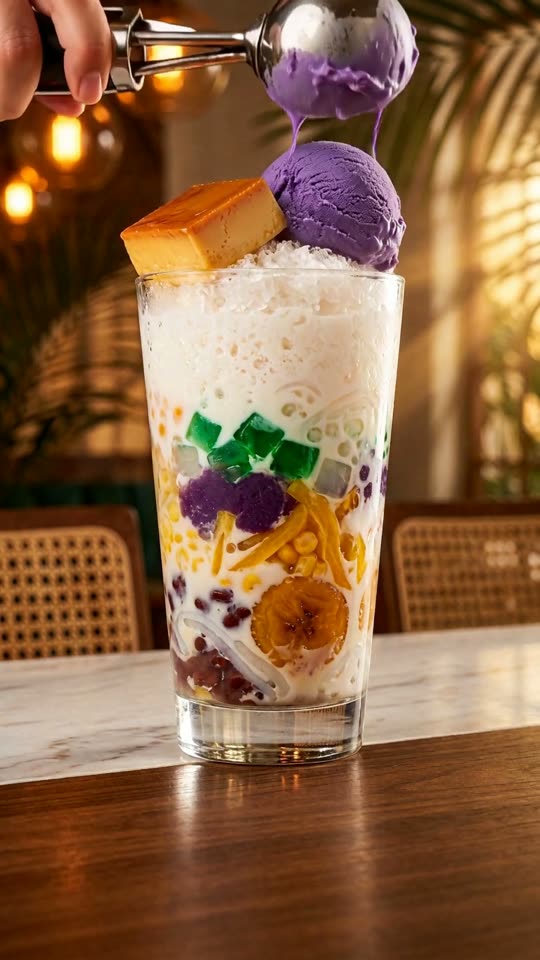
- Seat the leche flan crown: Using pastry tongs or a flat spatula, gently place a thick rectangular slice of golden caramel leche flan onto the left half of the milk-soaked shaved ice dome.
- Add the ube ice cream: Nestle a generous spherical scoop of deep-purple ube ice cream onto the right half of the shaved ice dome beside the leche flan.
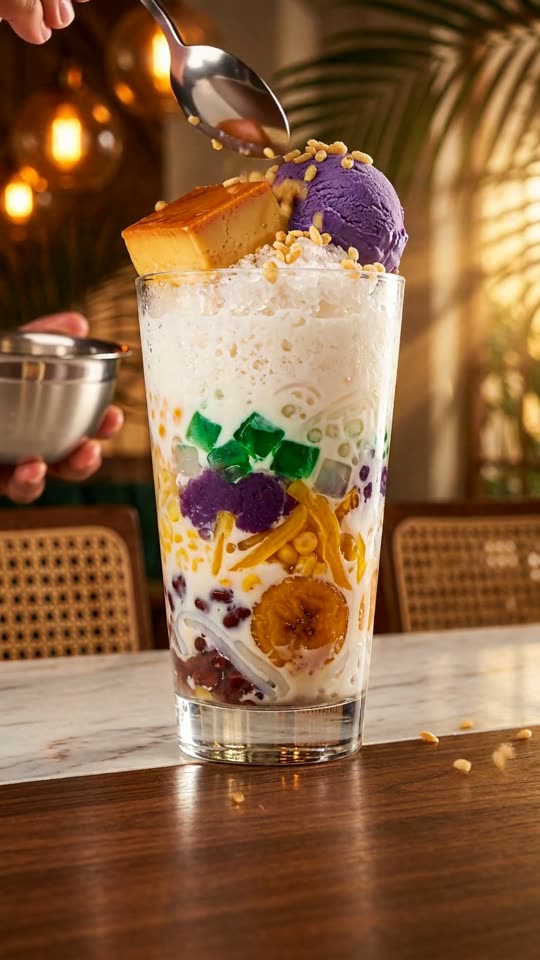
- Scatter the toasted pinipig and serve: Sprinkle crisp toasted pinipig rice flakes across the custard and ice cream crown so they stay dry until the first bite, then serve immediately with a long-handled spoon for mixing.
What mistakes ruin the texture of homemade halo-halo?
- Using coarse crushed ice instead of shaved snow: Blender-cracked ice shards block the spoon and dilute the milk slowly and unevenly. Use an ice shaver that produces compressible, snow-fine flakes.
- Pouring all the jar syrup into the glass: Commercial jars of macapuno, nata de coco, and sweet beans are packed in heavy sugar syrup. Spoon the solids with only a light gloss of syrup; excess liquid makes the drink cloying and melts the ice base.
- Adding pinipig before the milk: Pinipig—made from immature green glutinous rice pounded flat in wooden mortars and dry-toasted—loses its crisp exterior if soaked in milk early. Always scatter it last over the crown.
Frequently asked questions
Should you eat the leche flan and ube ice cream first or mix everything together?
Both approaches are traditional in the Philippines. As noted in accounts of halo-halo dining customs, many diners take a few bites of the rich leche flan and ube ice cream crown first so the custard and ice cream do not overly sweeten the glass, then plunge the long spoon to the bottom and churn the remaining ice, milk, and fruits together.
Can you use condensed milk or coconut milk instead of evaporated milk?
Evaporated milk is the classic choice because its unsweetened, roasted dairy flavor balances the heavily sugared fruit preserves at the bottom of the glass. Condensed milk makes the dessert overly sweet unless the bottom preserves are unsweetened, while fresh coconut milk is a popular dairy-free regional variation.
What is the difference between ube halaya and ube ice cream on top?
Ube halaya is a dense, fudge-like purple yam jam cooked with milk and butter—derived from an indigenous root crop (Dioscorea alata) with archaeological remains in Palawan dating back roughly 11,000 years—whereas ube ice cream freezes that flavor into a cold, aerated scoop. Many Manila parlors use both: a spoonful of ube halaya inside the glass and a scoop of ube ice cream on the summit.
What can you substitute for pinipig if you cannot find green rice flakes?
Authentic pinipig has a toasted, nutty chew that differs from airy puffed rice. If Filipino market pinipig or Vietnamese cốm is unavailable, lightly toasted rolled oat flakes or unsweetened crisp rice cereal scattered at the last second provide a comparable crunch.
Watch the short film
Watch the complete Royal Filipino Halo-Halo Supreme short film and follow our kitchen series on YouTube, Instagram, and TikTok.
AI-created visuals. Culinary inspiration, not a complete cooking guide.