The story and science behind the dish · recipe above ↑
The Black Eclipse: How to Layer a Blood Orange, Blackberry, and Mezcal Cocktail
Every late October, cocktail menus fill with drinks that rely on artificial food coloring or dry ice to look dramatic. You can build a far better-tasting, naturally three-layered Halloween cocktail in a heavy crystal rocks glass using nothing more than fruit sugar density, fresh blood orange juice, artisanal Oaxacan mezcal, and a thin float of activated-charcoal spirit.
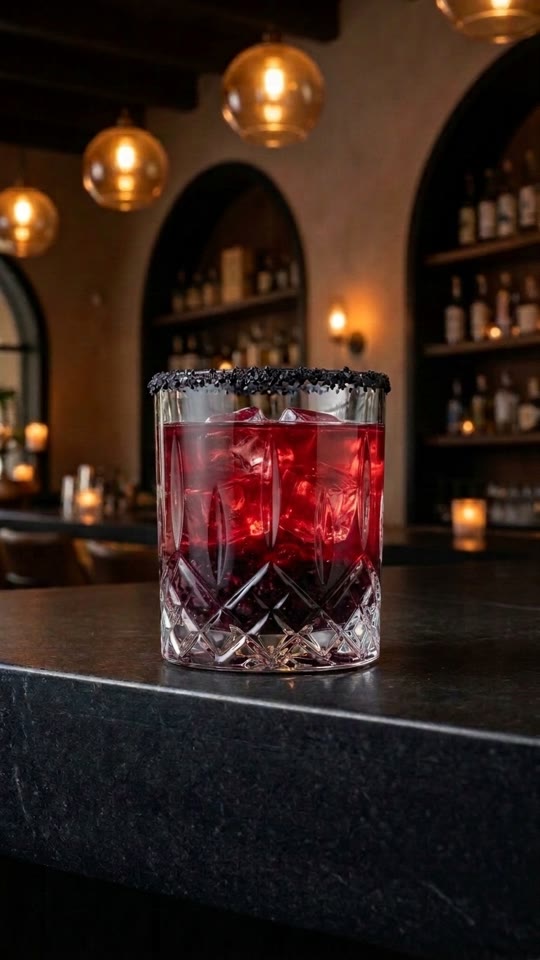
Known as The Black Eclipse, this drink stacks a deep purple-violet blackberry-agave base at the bottom of the glass, a glowing ruby-crimson blood orange and mezcal core through the middle over clear ice, and a velvety midnight-black float across the top rim. Crowned with a black volcanic salt rim, a dehydrated blood orange wheel, and a lightly torched rosemary sprig, it delivers smoky roasted agave, tart anthocyanin-rich citrus, and ripe bramble fruit in a single glass.
Where do mezcal citrus cocktails and black-layered drinks come from?
The backbone of this drink comes from Oaxaca, Mexico, where mezcal has been distilled from pit-roasted agave hearts (piñas) for centuries. Unlike tequila—which is produced exclusively from blue Weber agave steamed in above-ground industrial ovens or autoclaves—traditional artisanal mezcal is cooked in underground stone-lined pits fired with oak and mesquite wood before being crushed by a stone tahona wheel and fermented in open wooden vats. That underground roasting gives Espadín agave mezcal its signature notes of woodsmoke, roasted earth, and citrus peel.
In Oaxacan cantinas and contemporary Mexican cocktail bars, mezcal is traditionally paired with tart citrus, dark berries, and mineral salts. Meanwhile, the technique of floating contrasting spirits by specific gravity dates back to nineteenth-century American and European bar guides such as Jerry Thomas's The Bartenders Guide), which popularized layered pousse-café and float drinks. Modern craft bartenders adapted that density-layering principle to sour-style cocktails—most famously in the New York Sour, where a dry red wine float sits above a citrus-whiskey sour body—and in contemporary eclipse cocktails that suspend a low-sugar charcoal-tinted float over a denser citrus-and-syrup core.
How does liquid density keep the three layers separate?
Layered cocktails work because liquids with higher dissolved sugar concentrations have a higher specific gravity (density) than liquids with more water or alcohol. Pure ethanol has a specific gravity of roughly `0.789 g/mL` at `20°C (68°F)`, pure water sits at `1.000 g/mL`, and concentrated fruit-and-agave syrups climb above `1.15–1.25 g/mL`.
| Layer Position | Cocktail Component | Approximate Specific Gravity | Why It Stays in Place |
|---|---|---|---|
| Bottom layer | Crushed blackberry, raw agave nectar, and crème de mûre compote | `1.16 – 1.22 g/mL` | High dissolved fructose and sucrose from raw agave nectar and blackberry liqueur anchor the dark purple base at the floor of the glass |
| Middle core | Freshly squeezed blood orange juice, lime juice, and Oaxacan mezcal Joven | `1.01 – 1.03 g/mL` | Natural citrus sugars balanced with 40% ABV mezcal create a medium-density ruby core, buffered from the bottom layer by large clear ice cubes |
| Top eclipse float | 40% ABV vodka tinted with food-grade activated coconut charcoal | `0.94 – 0.95 g/mL` | Zero added sugar and 40% alcohol by volume make the charcoal vodka significantly lighter than the citrus-mezcal core below |
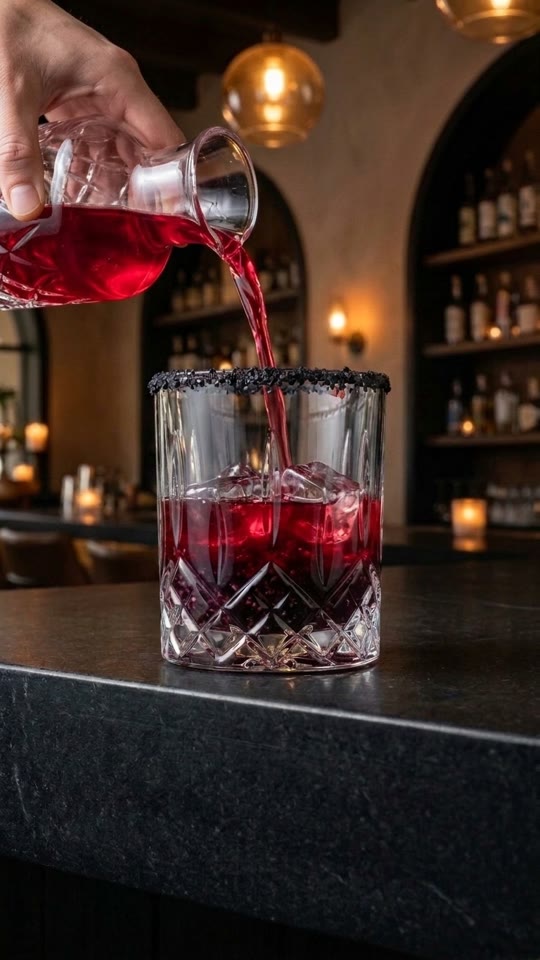
Packing the glass with large (`5 cm / 2 inch`) crystal-clear ice cubes before pouring the middle and top layers is essential. The flat faces of the ice cubes act as physical baffles that absorb the downward momentum of the pour so the lighter liquid spreads horizontally instead of plunging into the layer underneath.
Which ingredients matter most for flavor and color?
- Oaxacan Mezcal Joven (100% Agave Espadín): Look for an unaged (Joven) artisanal mezcal bottled at `40%–45% ABV` (`80–90 proof`). Its clean woodsmoke and roasted pepper notes cut through the sweet blackberry base without adding barrel-aged oak color that would muddy the crimson middle layer.
- Blood Oranges (Citrus × sinensis): Varieties such as Moro and Tarocco owe their deep ruby flesh to anthocyanins, antioxidant pigments that develop when the fruit ripens during cool autumn and winter nights. Freshly squeezed blood orange juice gives the middle layer an intense ruby translucency that regular navel oranges cannot match.
- Fresh Blackberries & Crème de Mûre: Muddling ripe blackberries with dark raw agave nectar and a splash of French blackberry liqueur (crème de mûre) creates a glossy, spoonable compote with enough density to resist upward mixing when the ice and citrus enter the glass.
- Food-Grade Activated Coconut Charcoal: A tiny pinch (`1/8 tsp / 0.4 g`) of ultrafine food-grade activated carbon made from coconut shells turns `30 mL (1 oz)` of neutral vodka jet-black without altering its flavor or raising its density.
- Black Lava Salt (Hawaiian Hiwa Kai): Coarse black sea salt bonded with activated volcanic charcoal gives the rim a crisp mineral crunch that brightens every sip of tart blood orange and smoky agave.
How to build The Black Eclipse step by step at home
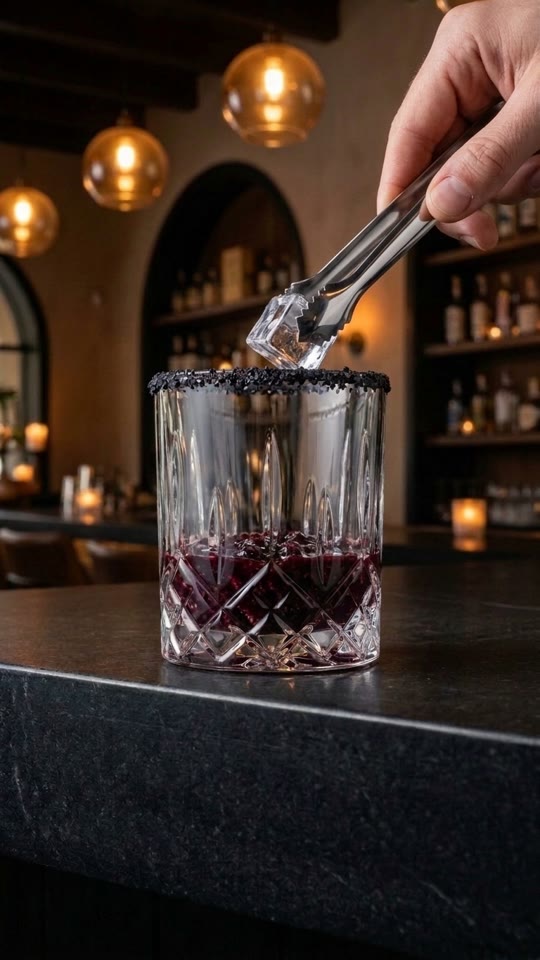
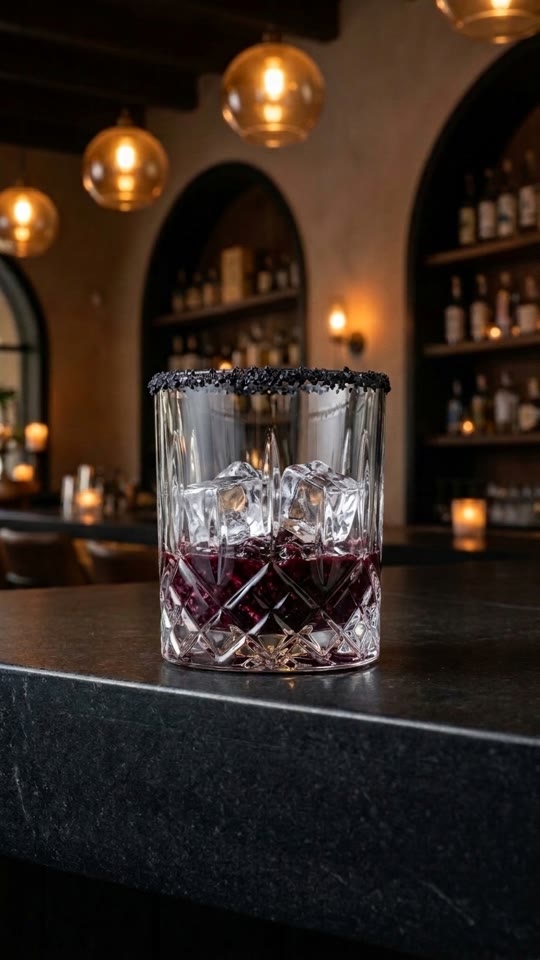
- Chill the glassware and apply the black lava-salt rim: Place a heavy diamond-faceted double old-fashioned crystal rocks glass (`320–350 mL / 11–12 oz` capacity) in the freezer for `15 minutes` (`0°C / 32°F`). Spread `1 tbsp (15 g)` of coarse black volcanic lava salt on a small saucer. Run a juicy lime wedge around the outer top `4 mm` of the chilled glass rim—keeping lime juice off the inside wall so it does not drip—and roll the outer rim in the black salt.
- Prepare the high-density blackberry-agave base: In a sturdy mixing glass, muddle `60 g` (`6` large) fresh blackberries with `22 mL (3/4 oz)` dark raw agave nectar and `15 mL (1/2 oz)` blackberry liqueur (crème de mûre) for `20 seconds`. Pass the mixture through a coarse mesh strainer, pressing with the back of a spoon to remove hard seeds while keeping a thick, glossy purple-violet compote. Chill in the refrigerator for `10 minutes` (`4°C / 39°F`).
- Whisk the midnight-black charcoal vodka float: In a small spouted glass beaker, whisk `1/8 tsp (0.4 g)` food-grade activated coconut charcoal powder into `30 mL (1 oz)` chilled vodka (`-4°C / 25°F`) for `15 seconds` until completely dissolved and free of clumps. Do not add syrup or liqueur to this mixture, or it will sink through the drink.
- Spoon the blackberry base into the bottom of the glass: Using a long-handled bar spoon, transfer the chilled blackberry-agave compote straight into the center of the glass floor until it fills roughly the bottom quarter of the glass. Keep the upper glass walls completely clean so the ruby layer remains transparent.
- Pack with clear ice and chill the crimson mezcal core: Using bar tongs, lower `3 to 4` large crystal-clear artisan ice cubes (`5 cm / 2 inch`) gently onto the blackberry compote. In a separate mixing glass filled with ice, stir `60 mL (2 oz)` Oaxacan Espadín mezcal, `60 mL (2 oz)` freshly squeezed strained blood orange juice, and `15 mL (1/2 oz)` fresh lime juice for `12 seconds` (`2°C / 36°F`) so the middle layer is cold and diluted before it touches the glass.
- Pour the ruby-crimson core and float the black eclipse layer: Strain the chilled blood orange and mezcal mixture slowly directly over the top face of the highest ice cube so it cascades gently around the ice without disturbing the purple blackberry base. Next, hold the back of an inverted bar spoon inside the glass wall `2 mm` above the ruby surface and trickle the `30 mL (1 oz)` charcoal vodka slowly over the rounded bowl of the spoon so it spreads into a `1.5 cm` midnight-black eclipse band across the top.
- Garnish and torch the rosemary: Seat a dehydrated blood orange wheel on the left rim and rest a cocktail pick skewering `3` fresh blackberries on the right rim. Lightly char the tip of a fresh rosemary sprig with a culinary butane torch for `2 seconds` until fragrant woodsmoke curls upward, tuck the sprig beside the blood orange wheel, and serve with a reusable glass straw so guests can taste each layer or stir them together.
What mistakes cause the layers to blur together?
- Pouring warm mezcal and blood orange juice over the ice: Room-temperature liquid melts the outer surface of the ice cubes rapidly and creates downward convection currents that stir up the blackberry base. Always pre-chill and pre-dilute the mezcal and citrus in a separate mixing glass first.
- Using a black liqueur instead of dry charcoal vodka for the top float: Black sambuca, coffee liqueur, or black raspberry liqueur (Chambord) contain high levels of sugar (`1.08–1.18 g/mL`) and will immediately sink to the bottom of the glass instead of floating on top.
- Pouring from too high above the glass: Dropping liquid from more than `2 cm` above the ice drives a jet straight into the lower layer. Keep your spout or bar spoon right against the top ice cube or inside glass wall.
Explore more seasonal drinks and dinner pairings in our recipe archive, or reach out via our contact page with questions.
Frequently asked questions
Does activated charcoal change the flavor of the cocktail?
At `1/8 tsp (0.4 g)` per drink, culinary coconut-shell activated charcoal is odorless and flavorless, adding a matte-black color without grit. Keep the amount to a `1/8 tsp` culinary pinch per serving.
What can I substitute if blood oranges are out of season?
If fresh Moro or Tarocco blood oranges are unavailable, mix `45 mL (1.5 oz)` freshly squeezed ruby red grapefruit juice with `15 mL (0.5 oz)` unsweetened pure pomegranate juice to match both the ruby color and sweet-tart balance.
Can I make a non-alcoholic version of The Black Eclipse?
Yes. Keep the blackberry-agave compote unchanged, use `75 mL (2.5 oz)` chilled blood orange juice, `15 mL (0.5 oz)` lime juice, and `2 drops` liquid smoke for the middle layer, and float `30 mL (1 oz)` chilled soda water tinted with `1/8 tsp` activated charcoal on top.
AI-created visuals. Culinary inspiration, not a complete cooking guide.