The story and science behind the dish · recipe above ↑
Venetian Squid Ink Pasta with Spicy Arrabbiata and Creamy Burrata
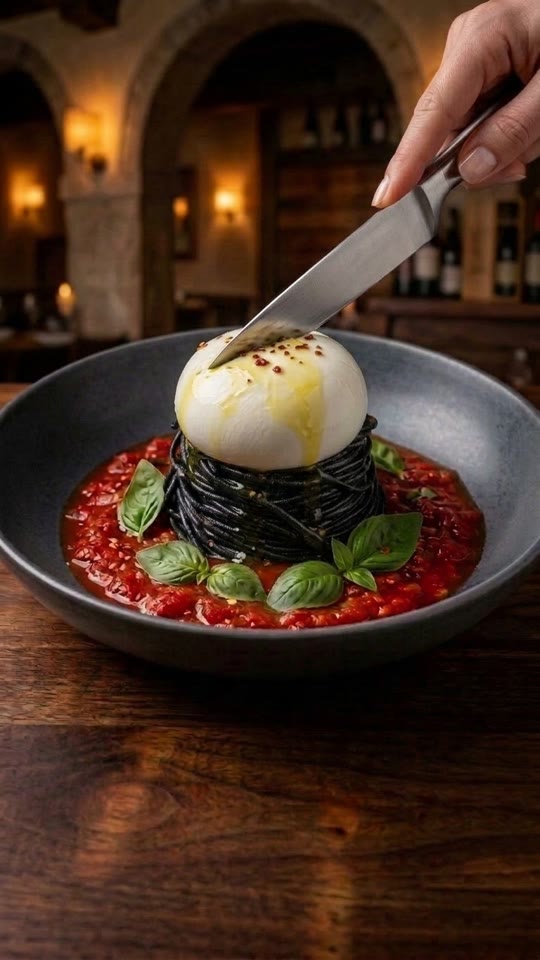
Natural squid ink pasta has one of the most striking color contrasts in Italian cooking: glossy, midnight-black strands that carry a subtle oceanic salinity without tasting fishy. While classic Venetian spaghetti al nero di seppia typically folds the pasta into a dark ink-and-cuttlefish pan sauce, pairing jet-black squid ink spaghetti with a bright ruby-crimson San Marzano arrabbiata base and crowning the hot pasta nest with a cold, creamy ball of Pugliese burrata creates an unforgettable three-color dish for an autumn dinner party or Halloween table.
Every bite balances three distinct regional Italian traditions: the briny nero di seppia pasta of the Venetian lagoon, the fiery garlic-and-Calabrian-chili arrabbiata of Rome and Lazio, and the lush stracciatella-filled burrata of Puglia.
Where do squid ink pasta, arrabbiata sauce, and burrata originate?
Cooking with cephalopod ink (nero di seppia) has deep roots along the Adriatic and Mediterranean coasts of Italy, particularly in Venice (Venezia) and Sicily. Venetian lagoon fishermen historically used every part of the cuttlefish (Sepia officinalis), harvesting the small ink sac carefully to season risottos (risotto al nero) and fresh egg or semolina pasta. As documented in historical accounts of squid ink as a food ingredient, cuttlefish ink owes its jet-black color to melanin granules suspended in a mucus rich in free amino acids—especially glutamic acid—which imparts a savory umami depth and gentle mineral brininess.
The crimson sauce underneath borrows directly from Roman sugo all'arrabbiata ("angry sauce"), a classic Lazio preparation built on extra-virgin olive oil, garlic, dried red peperoncino chilies, and crushed plum tomatoes. To temper the heat of the Calabrian chilies and echo the dramatic black-red-white contrast on the plate, the finished pasta nest is topped with fresh burrata, an artisanal cow's-milk cheese first crafted in the 1920s by Lorenzo Bianchino Chieppa in Andria, Puglia, by filling a thin spun-curd mozzarella pouch with shreds of mozzarella soaked in fresh cream (stracciatella).
Why does emulsifying squid ink pasta in the skillet matter?
When artisanal bronze-die squid ink spaghetti boils in salted water, surface starch granules gelatinize and leach into the cooking water. At the same time, stirring a spoonful of pure cuttlefish ink into the pan with starchy pasta water, extra-virgin olive oil, and a ladle of reduced San Marzano tomato sauce creates a stable oil-in-water emulsion (mantecatura) that clings to every strand instead of pooling watery at the bottom of the bowl.
| Component in the Dish | Culinary Role | Ideal Serving Temperature | Key Flavor & Texture Contribution |
|---|---|---|---|
| Bronze-die squid ink spaghetti + cuttlefish ink glaze | Structural centerpiece | `68°C – 75°C (154°F – 167°F)` | Firm al dente bite, mirror-black sheen, and savory marine umami |
| San Marzano DOP arrabbiata sauce | Base pool in the warm bowl | `75°C – 82°C (167°F – 180°F)` | Bright acidity, sweet concentrated tomato body, and fragrant Calabrian chili heat |
| Pugliese burrata (`stracciatella` core) | Cold-to-warm contrast crown | `16°C – 18°C (60°F – 64°F)` | Cool, buttery cream cascades into the spicy tomato sauce when sliced open |
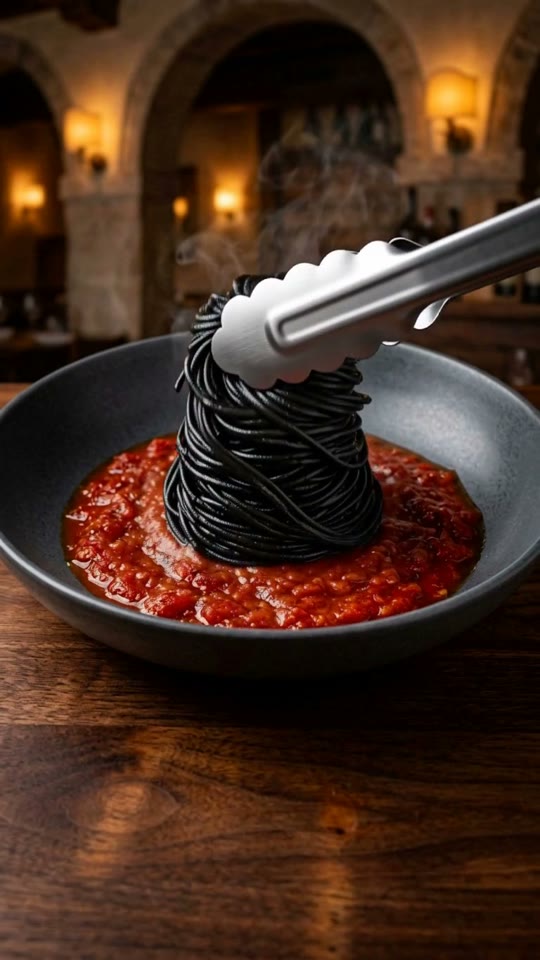
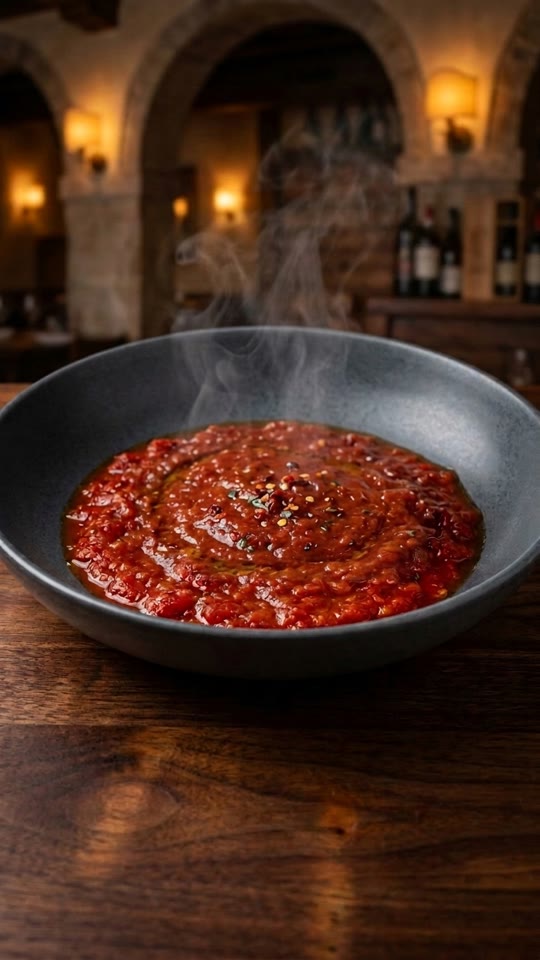
Plating the main pool of ruby arrabbiata sauce on the floor of the bowl first—rather than drowning the black pasta in red sauce inside the skillet—preserves the clean visual separation between the glossy midnight-black spaghetti nest and the crimson tomato pool below.
Which ingredients make the biggest difference at home?
- Bronze-Die Squid Ink Spaghetti (Spaghetti al Nero di Seppia): Choose dried durum-wheat semolina pasta extruded through bronze dies and tinted with `2%–4%` natural cuttlefish ink, paired with `1 tbsp (15 g)` bottled Venetian cuttlefish ink (nero di seppia) to reinforce the midnight-black sheen in the pan.
- Canned San Marzano DOP Whole Peeled Tomatoes: Grown in the volcanic soil around Mount Vesuvius, San Marzano tomatoes have meatier walls, fewer seeds, and lower water content than standard plum tomatoes, allowing the arrabbiata sauce to thicken in `12 to 15 minutes` without turning pasty.
- Crushed Calabrian Chili Flakes (Peperoncino Calabrese): Fruity, moderately hot peperoncino chilies infuse the olive oil with warm capsaicin heat and a subtle smoky fruitiness.
- Fresh Pugliese Burrata: Remove the burrata from the refrigerator `20 minutes` before plating (`16°C–18°C / 60°F–64°F`) and pat it dry on paper towels so excess whey does not water down the hot pasta.
How to cook Venetian squid ink pasta with arrabbiata and burrata step by step
- Temper the burrata and prep the aromatics: Lift `2` fresh Pugliese burrata balls (`125 g` each) from their brine `20 minutes` before cooking (`16°C–18°C / 60°F–64°F`) and pat dry on paper towels. Peel and slice `5` large garlic cloves (`25 g`) into paper-thin `1 mm` disks, finely mince `15 g` flat-leaf parsley, and crush `400 g (14 oz)` whole peeled San Marzano DOP tomatoes by hand in a bowl into rustic `1 cm` pieces.
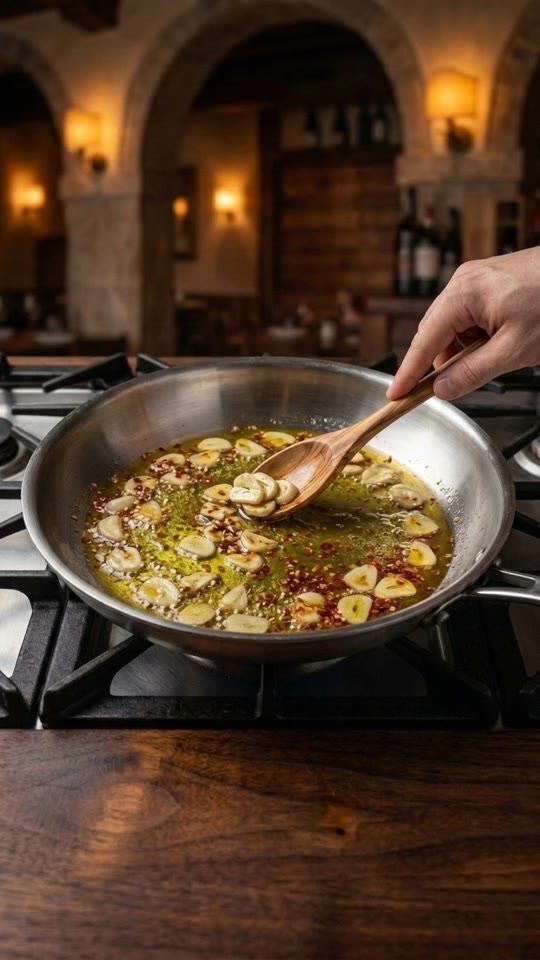
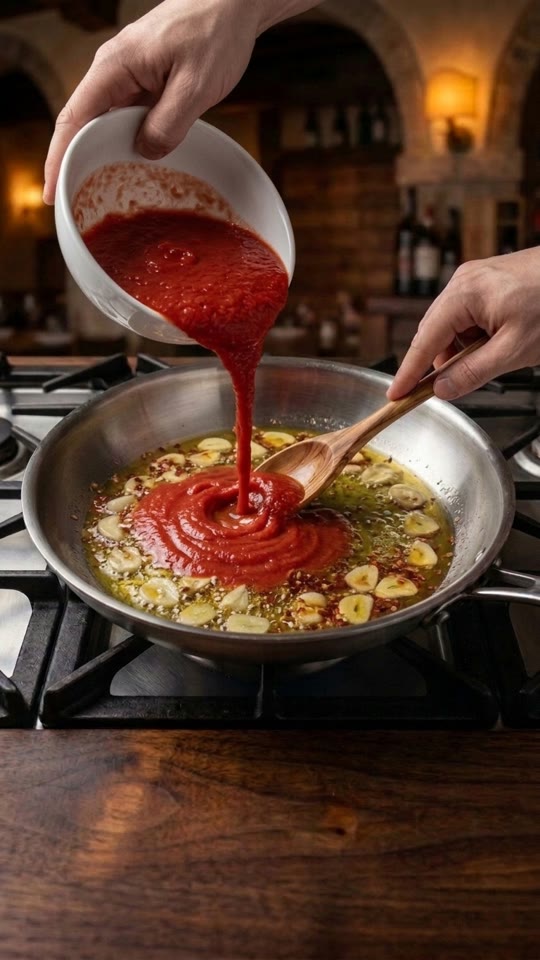
- Infuse the garlic and Calabrian chili oil: Set a wide `30 cm (12-inch)` stainless-steel skillet over medium-low heat (`135°C / 275°F`). Pour in `60 mL (1/4 cup)` extra-virgin olive oil, add the sliced garlic and `1.5 tsp (4 g)` crushed Calabrian chili flakes, and cook gently for `2.5 to 3 minutes`, stirring with a wooden spoon until the garlic turns pale golden at the edges without browning.
- Deglaze with white wine and simmer the ruby arrabbiata: Raise the heat to medium (`165°C / 330°F`), pour in `60 mL (1/4 cup)` dry Italian white wine (Pinot Grigio or Soave), and simmer for `90 seconds` until reduced by half. Add the hand-crushed San Marzano tomatoes and `1/2 tsp (3 g)` fine sea salt, reduce heat to medium-low (`95°C / 203°F`), and simmer uncovered for `12 to 15 minutes`, stirring occasionally, until thickened into a glossy ruby sauce. Ladle three-quarters of the hot arrabbiata sauce (`~240 mL / 1 cup`) into a warm heatproof pitcher for plating, leaving a thin `3 tbsp` glaze in the skillet.
- Boil the squid ink spaghetti al dente: Bring `4 L (4 quarts)` of water and `2 tbsp (30 g)` coarse sea salt to a rolling boil (`100°C / 212°F`) in a deep stockpot. Drop in `340 g (12 oz)` bronze-die squid ink spaghetti and boil for `8 minutes`—`90 seconds` shy of the package time—until flexible with a firm al dente core. Reserve `180 mL (3/4 cup)` starchy pasta cooking water before draining.
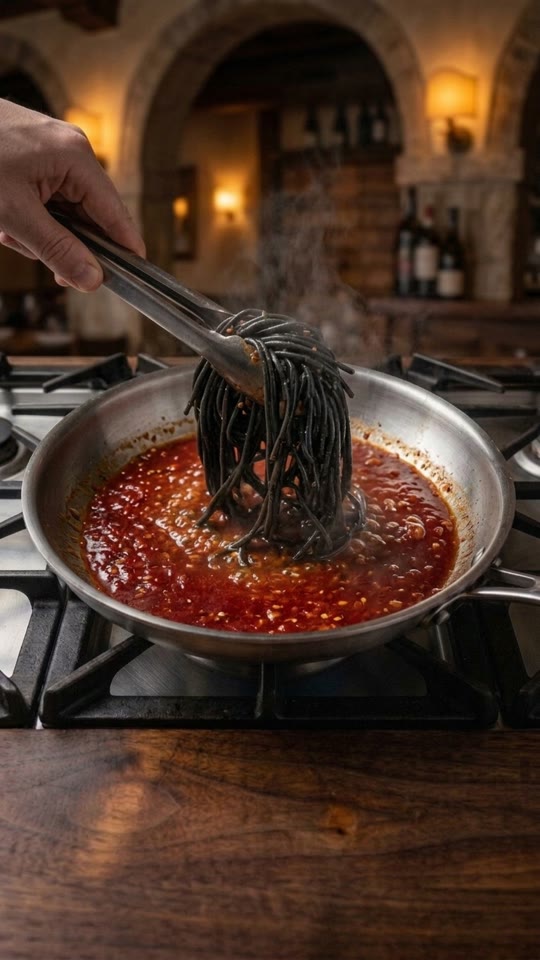
- Emulsify with cuttlefish ink in the skillet (mantecatura): Using kitchen tongs, transfer the dripping squid ink spaghetti directly into the skillet over medium heat (`150°C / 300°F`). Add `1 tbsp (15 g)` pure cuttlefish ink (nero di seppia), `90 mL (6 tbsp)` hot starchy pasta water, and the minced parsley. Toss and swirl vigorously for `60 to 90 seconds`, adding splashes of pasta water as needed, until the starchy liquid and olive oil emulsify into a mirror-glossy black coating on every strand.
- Ladle the crimson base and twirl the pasta nest: Spoon a generous pool of the reserved hot ruby arrabbiata sauce (`~120 mL / 1/2 cup` per serving) into the center of each warmed matte charcoal or dark stoneware pasta bowl. Grip a portion of the squid ink spaghetti with long plating tongs, twist inside a deep ladle to form a tall vertical cylinder, and set the glossy black pasta nest squarely in the center of the crimson tomato pool.
- Crown and slice the burrata at the table: Gently place a whole tempered burrata ball directly on top of the hot black pasta nest, tuck fresh basil leaves around the base, and drizzle the top of the burrata with extra-virgin olive oil, flaky sea salt, and a pinch of red chili flakes. Slice across the top of the burrata with a sharp knife right before eating so the creamy white stracciatella spills down the black spaghetti into the spicy red sauce.
What mistakes can ruin squid ink pasta or burrata?
- Browning the garlic in overheated oil: If the olive oil exceeds `160°C (320°F)` when the thin garlic slices go in, the garlic turns bitter and acrid within seconds. Start in a warm pan over medium-low heat so the garlic infuses gently.
- Serving ice-cold burrata straight from the fridge: At `4°C (39°F)`, the cream inside burrata stiffens and mutes its sweet dairy aroma. Tempering the cheese for `20 minutes` at room temperature lets the stracciatella flow smoothly when cut.
- Mixing all of the red arrabbiata sauce into the black pasta in the skillet: Tossing the full batch of tomato sauce with the cuttlefish ink turns the entire dish muddy brown. Keep the main pool of ruby arrabbiata sauce separate on the floor of the bowl and emulsify the pasta with only a thin glaze in the skillet.
Browse more regional Italian dishes and seasonal recipes in our recipe collection, or send us a note on our contact page.
Frequently asked questions
Does squid ink pasta taste strongly of fish?
No. High-quality dried squid ink pasta and culinary cuttlefish ink (nero di seppia) taste mildly briny and savory—similar to a gentle sea-breeze salinity and umami richness—rather than fishy. If ink smells harsh or ammoniated, it is past its prime and should be discarded.
Will cuttlefish ink permanently stain my cookware or teeth?
Cuttlefish ink rinses cleanly off stainless-steel pans, glazed stoneware bowls, and enamel with warm soapy water. Because raw wooden spoons and porous marble countertops can absorb dark pigment, use stainless-steel tongs for tossing the pasta and wipe any spills on stone surfaces promptly. Any temporary dark tint on the tongue disappears after a few sips of water or wine.
Can I make this recipe with regular spaghetti if I cannot find squid ink pasta?
Yes. If dried squid ink spaghetti is unavailable at your local market, boil `340 g (12 oz)` regular bronze-die durum-wheat spaghetti and increase the bottled cuttlefish ink (nero di seppia) in the skillet to `2 tbsp (30 g)` diluted in `120 mL (1/2 cup)` starchy pasta water during the final `90-second` toss so the strands absorb the deep black color and briny flavor in the pan.
What can I use instead of white wine when deglazing the arrabbiata sauce?
If you prefer to cook without alcohol, replace the `60 mL (1/4 cup)` dry white wine with `60 mL (1/4 cup)` warm vegetable or seafood broth plus `1 tsp (5 mL)` white wine vinegar or fresh lemon juice to provide the same bright acidity that lifts the garlic and chili oil.
AI-created visuals. Culinary inspiration, not a complete cooking guide.